
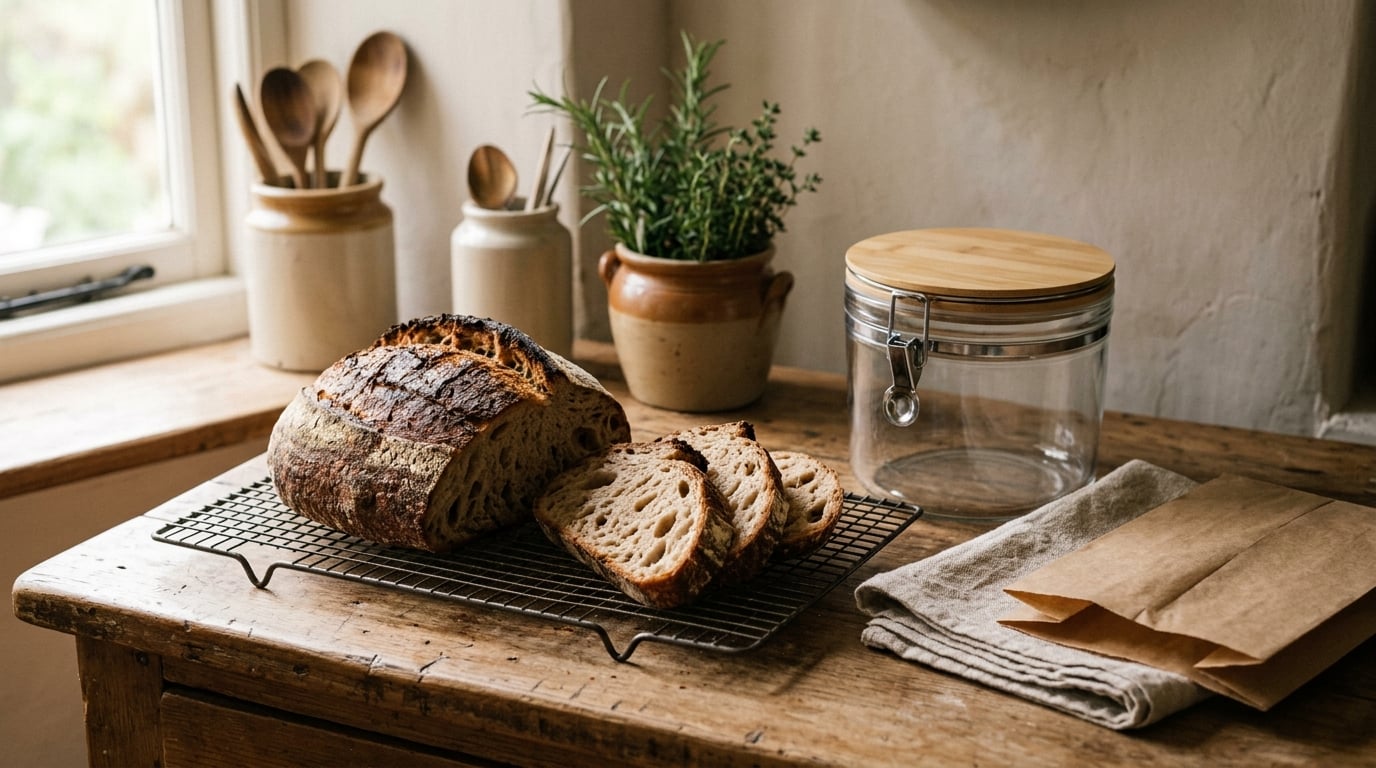
To store homemade bread so it stays fresh, cool the loaf completely on a rack, then match the wrap to the bread: paper or a cloth bag for a crusty sourdough, plastic or an airtight container for a soft sandwich loaf, and the freezer for anything past day four. Two to four days is realistic for homemade bread at room temperature. The refrigerator is the one place you should never put it.
That last point trips up more home bakers than anything else. Bread goes stale because starch molecules line up into crystals as moisture moves out of the crumb, and that happens faster in a cold fridge than on your counter. Freezing suspends the whole process, which is why the freezer is the only real answer for long storage.
What follows is the whole workflow, from the rack to the freezer bag, plus what to do with a loaf on day five. If you bake more than one loaf a week, the freezer section is the part that will actually change how you bake.
What You Need
None of this is expensive or specialized. Most people already have three or four of these items in a kitchen drawer.
- A wire cooling rack for the first hours, so air moves under the loaf instead of steaming the bottom.
- A paper bag, parchment or clean cotton and linen cloth for breathable storage of crusty bread.
- A plastic bag, plastic wrap or an airtight container for soft enriched loaves, sandwich bread and rolls.
- A bread knife and a cutting board for pre-slicing before freezing.
- Freezer bags or a vacuum sealer for double-wrapping, which is what stops freezer burn and odor transfer.
- A marker and masking tape or freezer tape for labeling and dating each portion.
- Parchment paper to slip between slices so they do not freeze into one block.
A bread box is optional. It is a box with a lid that holds a slow exchange of air, and plenty of people get the same result from a cotton cloth bag on a counter. If you like seeing your loaf on the counter rather than hiding it in a cupboard, that is the whole case for one.
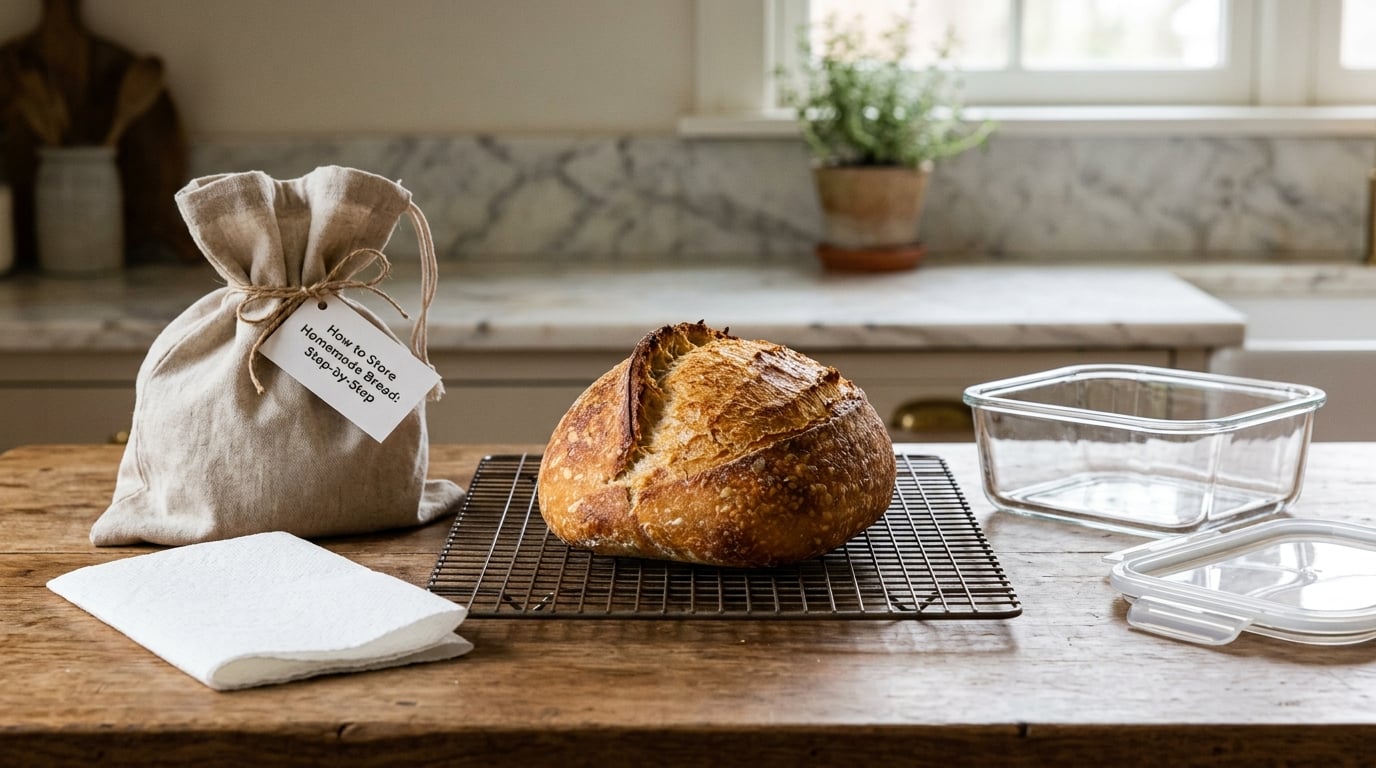
How to Store Homemade Bread: Step-by-Step
Choose the Right Storage Method for Your Bread
The method matters less than the type of bread. Crusty loaves, soft enriched loaves, rolls and topped breads each go stale and grow mold at different rates, and treating them all the same is why people end up with moldy sandwich bread on day three.
Crusty artisan bread, sourdough and baguettes want airflow. A paper bag, a cloth bag, or a board with a towel over it keeps the crust crisp and lets the crumb settle the way it should.
Soft enriched dough, sandwich loaves, milk bread and pan loaves want the opposite. Those breads are already moist, and they mold faster than sourdough, so they go into plastic or an airtight container and get used within two days.
Rolls, buns and bagels behave like soft bread but dry out faster because of the exposed surface area. Store rolls in a bag with a barely damp towel inside, and keep the bag closed.
Breads with toppings, seeds or a wetter crumb want the same treatment as soft bread. Cut them only once you are ready to eat, and keep the cut face sealed with plastic wrap or a clip.
There is one more split worth naming. Stale and dry are different problems, and they need opposite fixes. Stale bread is tough and hard but still moist, and heat brings it back. Dry bread is brittle and crumbly, and no amount of reheating brings moisture back, which is a wrapping problem, not a reheating problem.
Store Crusty Bread Without a Softening Crust
Put a cooled crusty loaf cut-side down on a wooden board, then drape a clean cotton or linen towel over it. That is the oldest method and it works well for the first day, when the bread still has plenty of its own moisture.
For days two through four, move the loaf into a paper bag with the seam folded loosely, or a linen bread bag. Bakers on r/Breadit describe this shift clearly, and their answer is that uncovered storage wins the first 12 hours and a bag handles the rest.
You will know it is working when the crust still crackles under your thumb and the crumb gives with a little resistance rather than crumbling. If the crust feels leathery, the bread is losing moisture, so add a layer of plastic or a bread box.
Sourdough and rustic loaves usually hold up four to six days this way, sometimes a week in a bread box, though the crumb firms up long before the flavor goes. Sourdough’s acidity works against mold, which is why it outlasts a sandwich loaf under identical conditions.
In a humid kitchen, paper and cloth are almost always right. In a dry, heated kitchen, a crusty loaf will lose its crust faster, so a bread box or a bag with a plastic layer is worth using there.
Store Soft Bread in an Airtight Container
Once a soft loaf is completely cool, wrap it tightly in plastic wrap or slide it into a resealable bag. Squeeze the air out before sealing; trapped air is what the crumb loses moisture into, and it is also what lets mold grow in a sealed bag.
An airtight container works the same way and takes up less counter space. Set the loaf on a piece of parchment on the container floor so the soft bottom does not stick and go gummy.
If you have a second loaf, use two containers. Stacking loaves in one airtight box traps warm, moist air around the lower loaf, and that is the most common reason a sandwich loaf turns fuzzy at the corners while the top slice still looks fine.
The sign that airtight storage is working is simple: the cut face stays squishable at day two. Enriched loaves with milk, eggs, butter or honey are the ones that go moldy first, so plan to freeze anything past the second day rather than hoping for the best.
Freeze Bread for Longer Storage
Freezing is the only method that reliably buys you months. Freezer storage for a sliced loaf runs three to six months, and a whole crusty loaf keeps well for two to three months before the crust starts to pick up freezer flavors.
Cool the loaf fully first. A single drop of condensation forming under plastic and then thawing is the number one cause of freezer burn, and warm bread releases plenty of its own steam.
Slice the loaf before freezing rather than after. Thin slices freeze faster, thaw in a lunchbox by morning, and give you portions instead of one frozen brick. For a crusty loaf, freeze it whole so the crust is not crushed by knife marks.
Wrap it twice. Put the sliced loaf in a freezer bag, press out the air, seal it, and then put that bag inside a second freezer bag or wrap it in foil. Double wrapping is the difference between bread that tastes like bread in March and bread that tastes like a freezer.
Slip a sheet of parchment between groups of slices if you plan to pull them apart one at a time. Without it, slices freeze into a single block and you break the whole loaf apart to get the one slice you wanted.
Label the bag with the bread type and the date. Frozen bread has no visible clock on it, and a freezer full of identical white bags is how whole loaves get forgotten until the freezer gets reorganized.
Thaw bread in the bag on the counter, or take the slices out the night before and put them back in the bag. Never refreeze bread that has been thawed and sat out, and refresh the thawed loaf in a hot oven before serving.
Revive Bread That Has Lost Its Freshness
Staleness is reversible because the starch crystals that formed can be broken apart again with heat and moisture. The moisture must come from the bread itself or from a little water added in the oven, which is why the foil-wrapped method beats a dry toast.
Oven refresh, best result. Set the loaf in a 450F oven, spritz or drizzle the crust with a little water, wrap it in foil, and heat 10 to 15 minutes. Uncover for the last 5 minutes so the crust dries out and crisps again.
Toaster or toaster oven. A slice straight from the freezer toaster works with no thawing. For a toaster oven, put the slice cut-side up, run it through one dry cycle, then one cycle with a butter knife dabbed across the top. The second cycle steams it from the inside.
Skillet. A cut face in a buttered skillet over medium heat for two or three minutes a side gives you a soft crumb with a proper crust, which a microwave never manages.
Microwave, last resort. Wrap a slice in a damp paper towel for 10 to 15 seconds. It softens the crumb, but the crust turns gummy and stays that way, so use it for sandwiches, not for serving.
None of this works on bread that is actually dry rather than stale, because there is no moisture left inside to mobilize. That bread is still perfectly usable, just in a different form: toast it hard and it becomes a salad crouton, or cube it for stuffing, or soak it and turn it into pudding.
Common Mistakes
Wrapping bread while it is still warm. The loaf gives off steam, that steam gets trapped, and you end up with a wet crumb and a soft crust within hours. The fix is simple and non-negotiable: cool on a rack for one to three hours, until the bottom of the loaf no longer feels warm at all.
Putting a crusty loaf straight into plastic. The crust turns leathery and the loaf can pick up off-flavors from the bag. Keep a paper layer between the bread and the plastic so the loaf still breathes while the moisture stays in.
Refrigerating bread to make it last. This is the big one. Starch crystallizes fastest in the 36 to 40F range, roughly six times faster than at room temperature, so a loaf that would last three days on the counter can be inedible in one night in the fridge. The fridge is for bread you intend to eat the same day.
Freezing slices unwrapped or bare. Freezer burn, odors from the frozen peas, and a crumb that turns to crumbs. Slice first, double wrap, label, and keep the bag flat so nothing presses on it.
Ignoring early mold. Cutting a green or fuzzy patch off a loaf and eating the rest is not safe; the hyphae run deeper than what you can see. Trim around a loaf that has a small spot and eat that part quickly, and throw out anything with a musty smell, widespread growth, or soft, watery patches.
Baking a week’s supply at once. Many bakers on r/Baking and r/Breadit avoid the waste problem entirely by keeping bulk dough in the refrigerator and baking a small loaf each day. Dough keeps a few days cold; baked bread does not.
Tips for Keeping Bread Fresh Longer
Date everything. A piece of freezer tape with the bread type and the date on it removes the guessing, and it is the fastest habit to build.
Keep bread types separate. A sourdough loaf next to a soft sandwich loaf means both lose: the sourdough dries toward the softer loaf’s moisture level, and the sandwich loaf picks up the sourdough’s strong aroma.
Plan thawing before the meal, not at it. A frozen loaf needs two to three hours on the counter, so put it out at breakfast for a dinner slice. Trying to thaw bread while the pasta boils is how you end up eating toast again.
Adjust the wrap to your kitchen. Humid rooms call for paper and cloth. Dry, heated rooms call for plastic, a bread box, or a layer of each, and the same loaf can be stored successfully in both if you change the wrap.
Use a bread box for what it is: a slower moisture exchange than an open counter, and nothing more. A linen bag does the same job for most people at a fraction of the footprint, and it looks better sitting on the counter.
Freeze in the shape you will use. Rolls go in a single layer so none of them get crushed, sandwich bread goes in slices, and a crusty loaf goes in whole. Pre-portioning into sandwich bags is the habit that stops a baked batch from going to waste.
At the formula level, an acidic or prefermented dough outlasts a plain one because the acid slows the growth of mold. A loaf baked with a ripe preferment or a long sourdough fermentation will still be the last one on the counter to grow fuzz.
Frequently Asked Questions
Is it better to store fresh bread in paper or plastic?
It depends on the bread and how long you are keeping it. Paper or cloth suits a crusty sourdough or baguette for two to four days, because airflow keeps the crust crisp. Plastic or an airtight container suits a soft sandwich or enriched loaf, which would dry out in paper but molds quickly in a sealed bag.
Is it better to leave bread on the counter or in the fridge?
The counter, every time. Starch molecules in bread form the crystals that cause staling fastest at refrigerator temperatures, roughly 36 to 40F, so a loaf can go hard in a single night in the fridge while staying soft twice as long on the counter. Freeze it instead if you need to keep it past a few days.
Can I store my homemade bread in a Ziploc bag?
Yes, for soft bread, and for crusty bread for no more than a day or two. Squeeze the air out and seal it fully so the crumb does not lose moisture into the trapped air. If you have a sourdough or artisan loaf you want to keep crusty for several days, put a paper or cloth layer inside the bag.
How do the Amish store bread without preservatives?
They use the oldest trick there is, and it is a method most home bakers can copy: a cool, well-ventilated room, bread kept on wooden shelves or in cloth-covered bins rather than plastic, and baking more often in smaller batches. Cool dry air and airflow are what keep bread from molding without any preservatives at all.
Will bread get moldy in a bread box?
It can, but less often than in a sealed plastic bag because a bread box lets moisture leave slowly instead of trapping it. Sourdough and rolls will usually stay mold-free in a bread box for a week because the crumb is less moist. A soft enriched loaf with milk, egg or honey is the one to watch, and check it every couple of days.
Is mold on sourdough bread bad for you?
Treat it as unsafe rather than salvageable. The visible green or fuzzy patch is only the surface; mold roots spread through the crumb in threads you cannot see, and some of them produce toxins that are not destroyed by reheating or by cutting the spot away. If a loaf smells musty or shows soft watery patches, discard the whole loaf.
Conclusion
Start with the step that costs nothing: let the loaf cool completely on a rack, which takes one to three hours, and never put bread in the fridge. After that, match the wrap to the bread, paper or cloth for crusty loaves and plastic for soft ones, and freeze whatever you will not eat within four days. Double wrap the frozen portion, date it, and give it a 450F oven refresh before you serve it.