
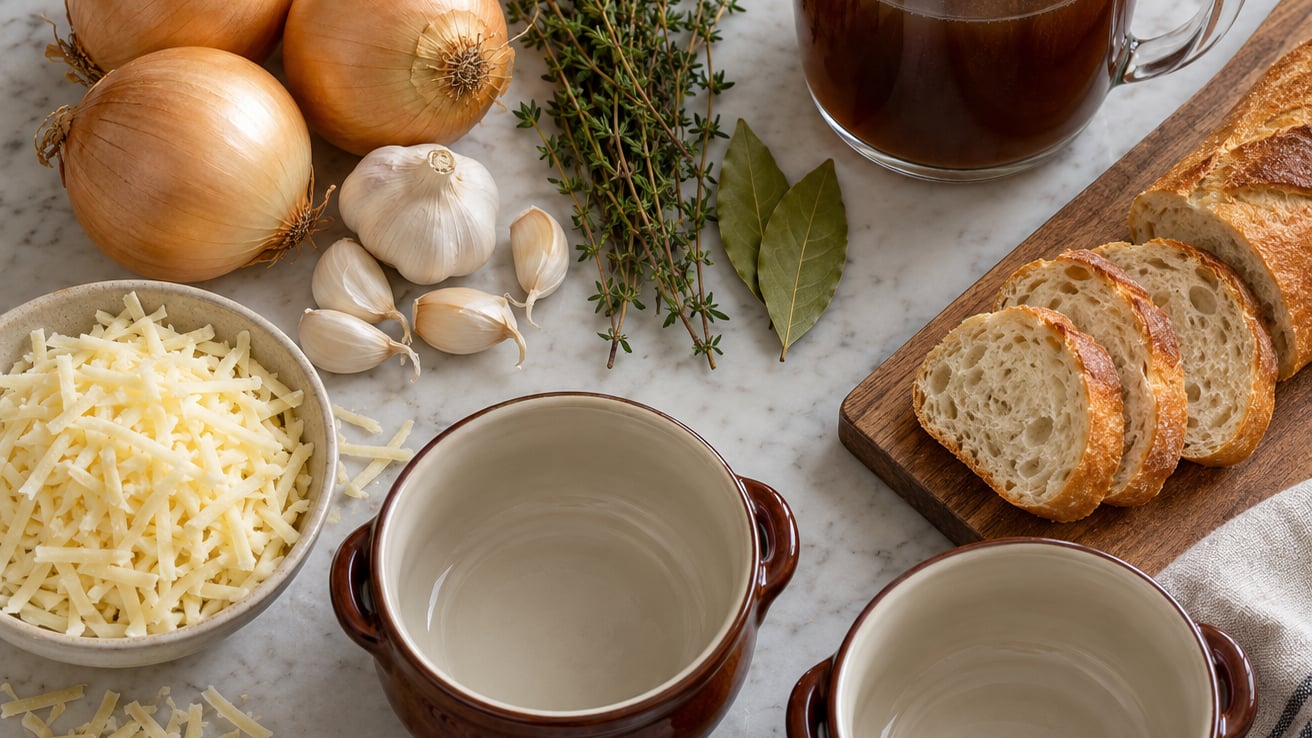
French onion soup at home comes down to patience. Slice 3 to 4 pounds of yellow onions thin, cook them slowly in butter for 45 to 60 minutes until they turn deep amber, simmer the deglazed pan in beef stock, then finish each bowl under the broiler with toasted baguette and a blanket of Gruyère. Start to table it takes about 90 minutes, and roughly half of that is the onions sitting quietly in the pot.
Almost everything you taste in the bowl is the onion. A restaurant version is not fancier than a home one, it is just less impatient, so if you have one free hour with nothing else demanding your attention, this is a very forgiving dinner to make.
What You Need
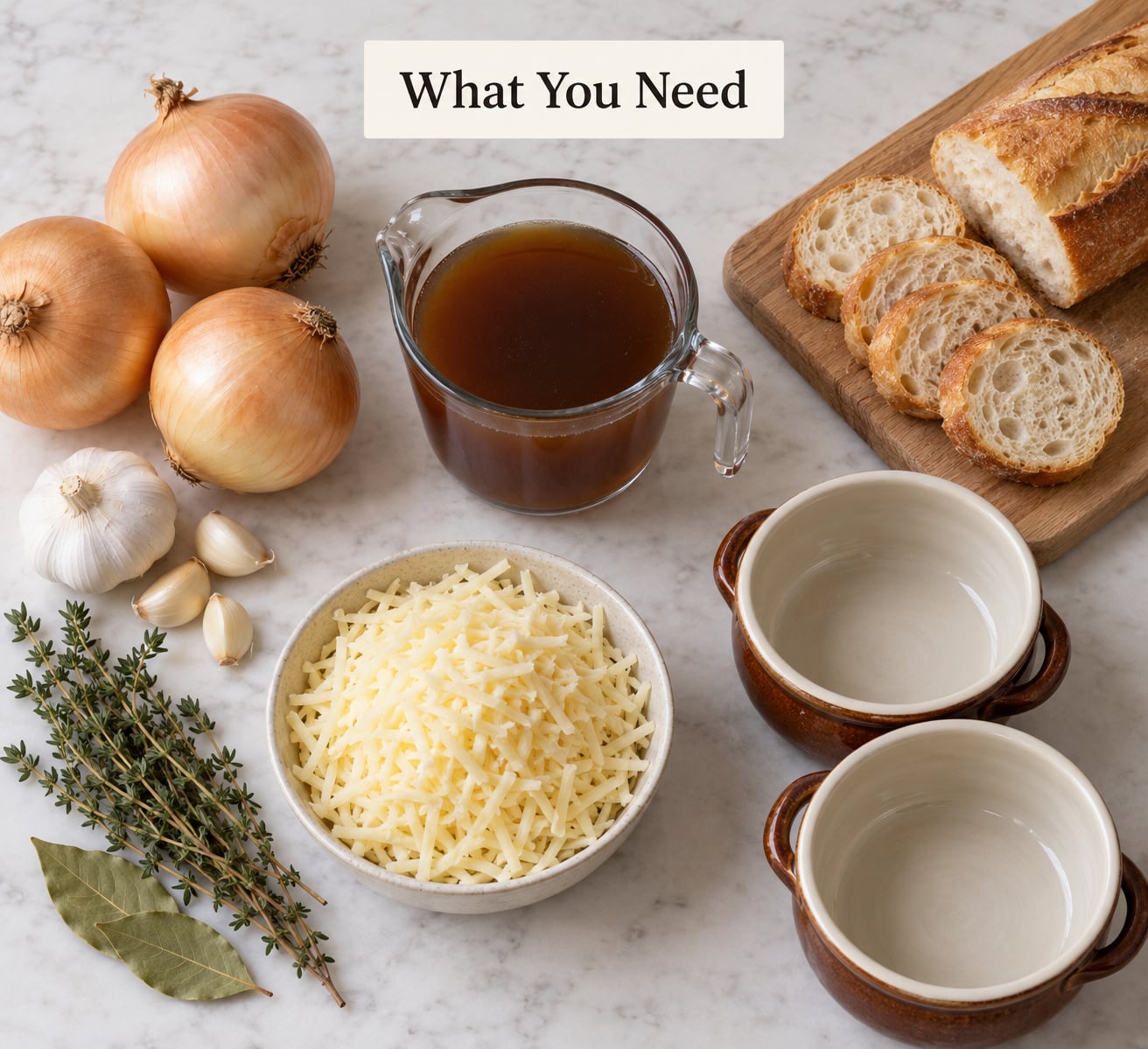
You need about ten ingredients and three pieces of equipment. Everything on the list below is either essential or an easy swap, and the quantities are written for four generous bowls.
Ingredients for Four Servings
- 3 to 4 pounds yellow onions, about 8 to 10 medium ones, peeled and sliced into thin half-moons
- 4 tablespoons unsalted butter, plus 1 tablespoon olive oil
- 1 teaspoon sugar (optional, to help browning)
- 1 tablespoon all-purpose flour (optional, to thicken)
- 1/2 cup dry white wine or dry sherry, to deglaze the pan
- 6 to 8 cups beef stock or broth
- 3 to 4 garlic cloves, lightly crushed
- 1 bay leaf and 4 to 5 fresh thyme sprigs
- 1 French baguette, sliced into 1/2-inch rounds
- 1 to 2 cups shredded Gruyère
- Kosher salt, black pepper, and Worcestershire sauce to taste
Yellow onions are the right call because they balance sugar and bite. If you want more sweetness, use three yellow and one red onion, and if you like sharper flavor, swap in a couple of white onions.
Equipment
- A 4 to 6 quart Dutch oven or heavy pot with a lid. Cast iron or stainless steel both hold heat steady, which is what you want here.
- A wooden spoon for stirring every few minutes without scraping.
- Oven-safe soup bowls or small casseroles, one per serving.
- A baking sheet for toasting the bread ahead of time, and a box grater if the cheese is not pre-shredded.
Skip the lid for most of the cooking. You use it early on, to sweat the onions, and you take it off for the long browning stage.
Easy Substitutions
- Chicken stock works, and so does half beef and half chicken, which is a trick that comes up constantly in cooking forums. The soup tastes lighter but nobody calls it wrong.
- Provolone, Swiss, mozzarella, or a mix all broil well. Gruyère gives the nutty, classic flavor, but a blend of mozzarella and provolone melts smoother and browns faster.
- Red wine can replace sherry or white wine. Add a teaspoon of balsamic vinegar or a splash of Worcestershire at the end if the soup tastes flat.
- No wine at all is fine. Deglaze with a little extra stock and let it reduce, then season harder.
- Sourdough or rustic white bread stands up to the broth better than a very soft loaf.
Step-by-Step: How to Make French Onion Soup at Home
The method runs in four movements: slice and sweat, brown slowly, build the broth, then broil. Give each stage the time it asks for and the soup assembles itself.
Step 1: Slice the Onions Thinly
Cut the root off each onion, leave the stem end intact so the layers hold together, and slice pole to pole into 1/4-inch half-moons. Thinner is better here, because thin slices release their water and then brown in roughly the same amount of time.
If your knife work is uneven, the thick pieces will still be pale while the thin ones are already dark, and that unevenness is usually why onions burn in a home kitchen. A mandoline or the slicer on your food processor gets you consistent pieces in seconds.
Salt the sliced onions lightly, about 1 teaspoon, and let them sit for 10 minutes. The salt draws out a little surface moisture, which means less steam in the pan and a shorter path to browning.
Step 2: Sweat and Caramelize the Onions for French Onion Soup
Melt the butter with the olive oil in the Dutch oven over medium-low heat. Add all the onions plus the sugar and the remaining salt, stir to coat, then cover and cook for 10 to 15 minutes until the onions slump and turn translucent. That covered stage is sweating, and it is a shortcut: trapped steam softens the onions without coloring them.
Now take the lid off, turn the heat to its lowest setting, and let them go. Stir with the wooden spoon every 5 minutes or so, scraping nothing, until the onions are deep golden brown and smell like toast rather than onion. Expect 45 to 60 minutes from the start, and a large pan full of onions will take closer to 75.
Here is what you are looking for at each stage, so you do not quit early.
| Elapsed time | What the pan looks like | What to do |
|---|---|---|
| 0 to 15 min | Onions soften and turn translucent under the lid | Covered, medium-low heat |
| 20 to 30 min | Liquid has mostly cooked off, onions are pale gold, heavy steam | Uncovered, lowest heat, stir every 5 min |
| 40 to 50 min | Deep gold, sticking slightly to the pot | Lower the heat further, scrape the fond up |
| 55 to 75 min | Dark amber-brown, soft, sweet, jammy | Done. Do not push past this for a deeper color |
The heat setting matters more than the clock. Medium or higher is the single most common reason home French onion soup fails: the outside of each slice scorches before the inside loses its water. If the pan is bubbling hard, your flame is too high.
Stay close for the last 15 minutes. Fond that darkens past chestnut brown turns bitter fast, and a few black flecks in the finished soup are hard to hide behind cheese.
Step 3: Build the Broth
Turn the heat up to medium and pour in the wine or sherry. Scrape the bottom of the pot with the wooden spoon as it bubbles, loosening every browned bit, and let the liquid reduce by about half, 3 to 5 minutes.
Stir in the flour now if you want body; it will thicken the broth as it simmers and cook off any raw taste within a few minutes. Add the garlic, bay leaf, and thyme, then the stock a cup at a time, stirring as you go.
Bring it to a bare simmer, skim any foam, and leave the lid ajar for 25 to 30 minutes. Uncovered simmering is what you want, because it reduces the soup to a body that holds up under bread and cheese instead of tasting thin.
Season at the end, not the beginning. Add the Worcestershire, a splash of sherry if you skipped it earlier, and salt until it tastes slightly stronger than you think it should, because the broth loses punch once it is in a bowl with a hunk of bread in it.
Step 4: Toast the Bread and Broil the Soup
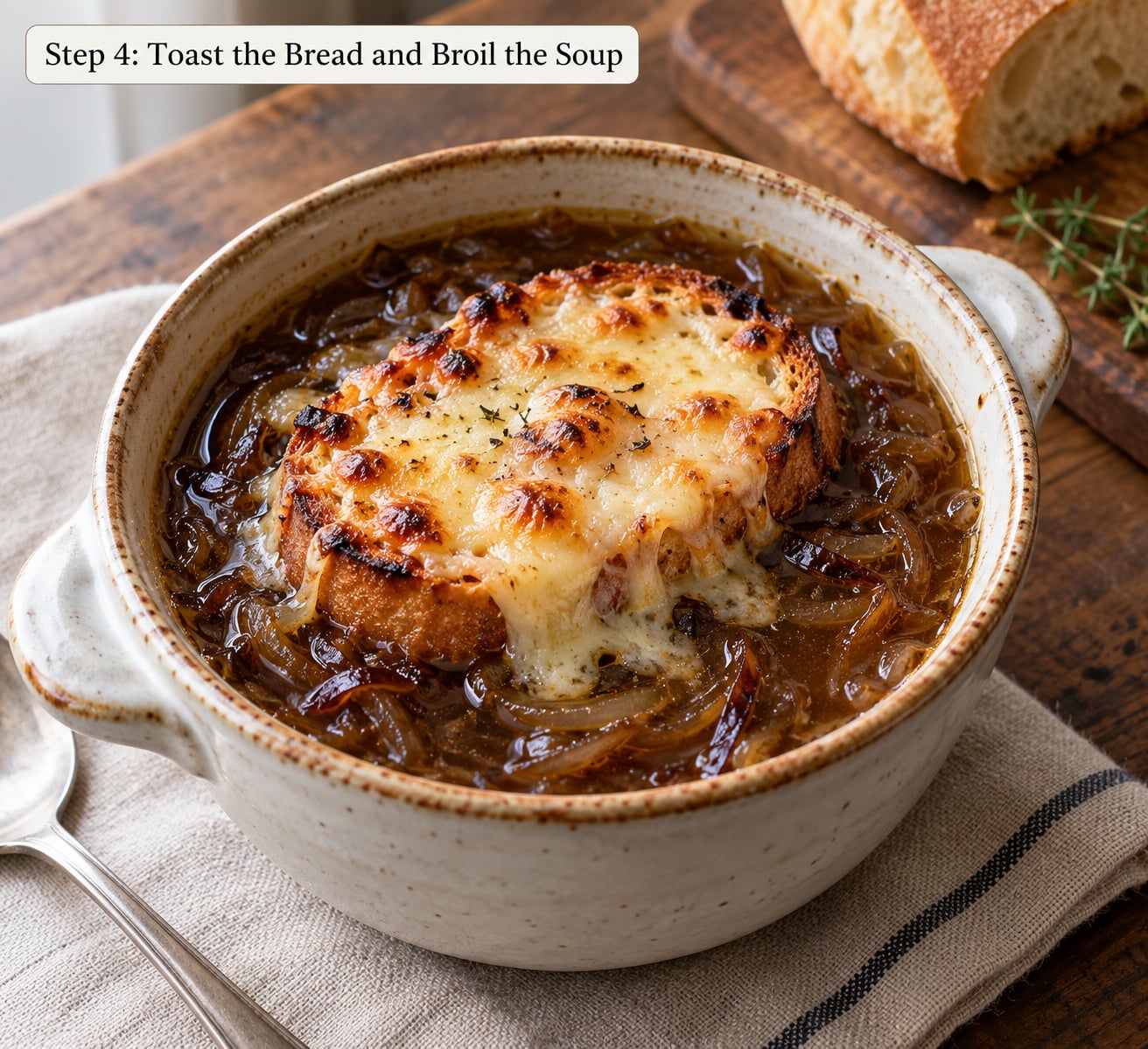
Set the oven to broil. Toast the baguette rounds on a baking sheet under the broiler for 2 to 3 minutes until they are dry and pale gold on both sides, and move on. Bread toasted ahead of time will hold its crunch indefinitely in the oven, which solves the soggy-crouton problem that trips up most first attempts.
Ladle the soup into the oven-safe bowls, leaving a centimeter or two of headroom. Float one or two toast rounds on top of each bowl, pile on 1/2 to 1 cup of shredded Gruyère, and put the bowls on a baking sheet in the broiler.
Broil for 3 to 6 minutes, watching the whole time, until the cheese is fully melted, bubbling, and spotted with brown. Pull it the moment the top blisters. Cheese goes from perfect to scorched in about 30 seconds, so stand there.
Rest each bowl for a minute before it goes to the table, since the bowls and the soup are both extremely hot. Black pepper at the table, and a small green salad if you want something cold against it.
Common Mistakes
Almost every disappointing bowl traces back to one of six things, and all six are fixable.
- Onions that scorch before they soften. Too much heat. Drop to the lowest setting your stove has, use a lid for the first 15 minutes, and give it the full 60 minutes before judging the color.
- Watery onions at the end. The pot was crowded, or you skipped the covered sweating stage. Too many onions steam each other instead of browning; cook in two batches if your pot is small.
- Weak, thin broth. You simmered covered, or not long enough. Simmer uncovered for 25 to 30 minutes, add the tablespoon of flour, and taste again.
- Soggy bread that falls apart. Wet bread sitting on top before broiling. Toast the rounds fully in the oven first, and add them to the bowl only when the soup is already hot.
- A greasy, rubbery cheese layer. Pre-shredded cheese, or too much of it. Buy a block and grate it yourself, use about 1/2 to 1 cup per bowl, and broil rather than baking.
- Soup that tastes flat. Seasoning added too early, or no acid. Salt after the simmer finishes, then add a splash of sherry, Worcestershire, or a teaspoon of balsamic vinegar.
If you are cooking for a crowd, the onions can be done a day ahead and refrigerated. Reheat gently, then assemble and broil fresh bowls, since the bread and cheese should never be reheated twice.
One word about slow cookers. They are popular for this soup, and they get the broth right, but the crock never gets hot enough at the surface to drive off moisture the way direct pan contact does, which is why slow cooker French onion soup so often comes out pale and the onions turn rubbery. It works as a hands-off variation. It just does not caramelize.
Frequently Asked Questions
How long should onions cook for French onion soup?
Plan on 45 to 60 minutes total, and closer to 75 if your Dutch oven is loaded with 4 pounds of them. The first 10 to 15 minutes are covered, to soften the onions without coloring them, then the lid comes off and they brown over low heat for the rest. Judge by color, not clock: deep amber-brown and jammy means done, and pale gold means keep going.
Do I have to use Gruyère cheese in French onion soup?
No. Gruyère is what gives the dish its classic nutty flavor, but Swiss, provolone, mozzarella, or a mozzarella and provolone blend all broil well and melt smoothly. Shred the cheese yourself from a block rather than using pre-shredded bagged cheese, which contains anti-caking agents that melt greasy and refuse to brown properly.
Can I make French onion soup in a slow cooker?
You can, and the broth comes out fine, but the onions rarely do. A slow cooker never gets hot at the surface, so it lacks the direct pan contact caramelizing needs, and the usual complaints are pale, watery onions with a rubbery bite. Brown the onions on the stovetop first, then transfer everything to the slow cooker for 4 to 6 hours on low and add the bread and cheese at the end under the broiler.
Why are my French onion soup onions watery?
Three causes account for almost every watery batch: the pan was too full, the heat was too high, or you lifted the lid while cooking. Crowded onions steam each other, and hot pans cook the outside of a slice before the water inside it can escape. Use a wide pot, cover for the first 15 minutes only, then cook uncovered at the lowest heat and stir every 5 minutes until the liquid has cooked away.
Can French onion soup be made ahead of time?
Yes, and it often improves overnight as the flavors settle. Make the soup through the simmering stage without the bread or cheese, cool it, and refrigerate it for up to 3 days or freeze it in a sealed container for up to 3 months. Reheat gently on the stove or in the microwave until steaming, then toast fresh bread, top the bowl with cheese, and broil for 3 to 6 minutes before serving.
What bread is best for French onion soup?
A day-old baguette or French bread sliced into 1/2-inch rounds is the standard choice, and day-old is better because it holds up in liquid. Sourdough and rustic white loaves also work. Toast the rounds fully in the oven before they ever meet the soup, and add only one or two per bowl, because wet bread sitting on top during the broil is the main cause of a mushy bowl.
Conclusion
Start by slicing the onions. Everything after that is just waiting, stirring, and paying attention to color, and the single technique that separates a great bowl from a disappointing one is slow caramelization at the lowest heat your stove allows. Give the onions the full 45 to 60 minutes, deglaze the pot with wine, simmer the broth uncovered, and broil the cheese only once everything else is done.
Put the pot on the stove first, and pull the bread out last. That is the whole trick to making French onion soup at home, and the same patience carries over to anything else that rewards a slow burner, like a restaurant-style tomato soup or a tray of croutons from stale bread for serving alongside.