
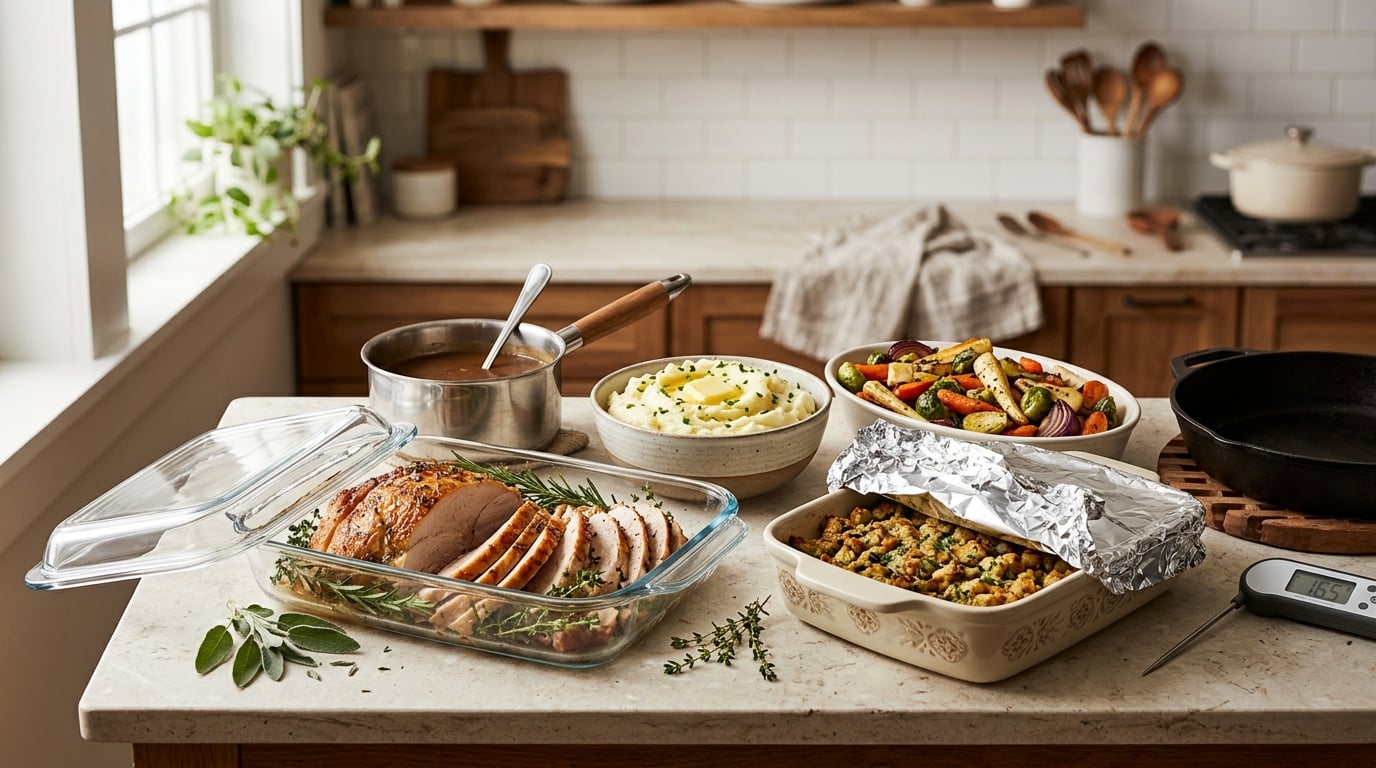
To reheat a holiday meal without drying it out, add a splash of moisture, cover the dish loosely, and use gentler heat than you would for cooking from raw. A splash of broth, pan juices or water goes in the pan, foil goes over the top, and the food heats slowly until steaming hot all the way through.
The microwave is the reason most reheated turkey turns into a piece of rubber. It heats the edges of a piece to boiling while the middle stays cold, and it drives water out of the meat faster than the oven does. That does not mean you need to avoid it, because it is still the fastest option for a single plate.
A holiday meal gets cooked hours, sometimes a full day, before anyone sits down. Reheating is where the texture is won or lost. Get it right and the turkey is still juicy, the potatoes are still creamy, and the stuffing still pulls apart moist.
Table of Contents
- What You Need
- Step-by-Step: How to Reheat a Holiday Meal Without Drying It Out
- Common Mistakes
- Frequently Asked Questions
- What is the best temperature for reheating holiday leftovers?
- How long do you reheat a holiday meal so everything stays hot?
- Should I cover leftovers with foil while reheating them?
- What is the safest way to reheat leftover turkey?
- How do I reheat mashed potatoes and gravy without making them soggy?
- Can I reheat a whole holiday meal the day before?
- Conclusion
What You Need
None of this is specialty equipment. Most of it is already in your kitchen, and a few pieces you can skip entirely.
- An oven-proof dish with a lid. A glass baking dish with a tight-fitting lid traps steam better than foil alone. A shallow dish heats faster than a deep one, so spread leftovers in a single layer where you can.
- An instant-read thermometer. This is the one tool worth having. Guesswork is how you end up with cold spots you thought were fine.
- A roll of aluminum foil. For tenting meat and casseroles, and for wrapping a dish that already went through one reheat.
- A skillet with a lid. The fastest, gentlest route for a single portion of turkey, chicken or ham.
- A little liquid. Chicken or turkey broth, pan drippings, defatted gravy, or plain water in a pinch. You need a couple of tablespoons per dish, not a pool.
- A damp paper towel or a microwave-safe lid. For anything that goes in the microwave.
Step-by-Step: How to Reheat a Holiday Meal Without Drying It Out
1. Check the leftovers and plan the order
Decide what is safe to reheat before you turn on an appliance. Refrigerated leftovers need to be eaten within three to four days, and anything that sat out past two hours at room temperature gets a much shorter grace period.
Frozen cooked turkey or chicken needs to thaw in the refrigerator, on a tray if you are nervous about drips, and that takes a full day or more. Never thaw it on the counter to save time.
Then think about order, because six dishes do not come ready at the same moment. Start with the things that can handle more heat and hold it: casseroles, potatoes, stuffing. Do the sliced poultry last, in short bursts, because it has the least margin for error.
2. Choose the right reheating method
Match the method to the dish, not to convenience. A dense baked casserole wants an oven. A single portion of sliced turkey wants a covered skillet. Wet, starchy sides want gentle heat or they turn gluey.
- Oven, 300 to 325F: the most even heat and the best result for casseroles, gratins, whole birds and large quantities of vegetables. An oven set higher than this cooks the edges before the center warms.
- Toaster oven: nearly as good as the full oven for one dish, and it heats up faster. Keep an eye on it, since the heating elements are much closer to the food.
- Covered skillet on the stovetop: the fastest and most moist option for meat. Add a splash of broth, cover, and turn the heat low.
- Microwave at 50 to 70 percent power: best for a single plate or a bowl. Full power is what dries food out and creates hot spots.
- Air fryer: useful for re-crisping skin or a fried turkey piece, at 300 to 325F for short bursts. It is a drying appliance, so use a light spritz of oil and keep the time down.
If you see a recipe calling for 425F to reheat leftovers, that is usually a recipe for crisping something that was refrigerated, not for gently restoring it. Save the high heat for skin and crusts.
3. Add moisture and cover gently
This is the step that decides whether the meal tastes good. Put two to three tablespoons of broth, pan juices or water in the dish before it goes in, directly under or beside the food rather than poured over the top.
Then cover. A tight lid is best. With foil, tent it loosely so a corner stands open, because sealed foil traps pressure and can puddle condensation that thins any sauce. The goal is warm, humid air around the food, not a steam bath.
Some cooks add a damp paper towel over the food inside the microwave. It works the same way, and it is easier than foil when you are working with a single plate.
4. Reheat turkey and other poultry without drying it out
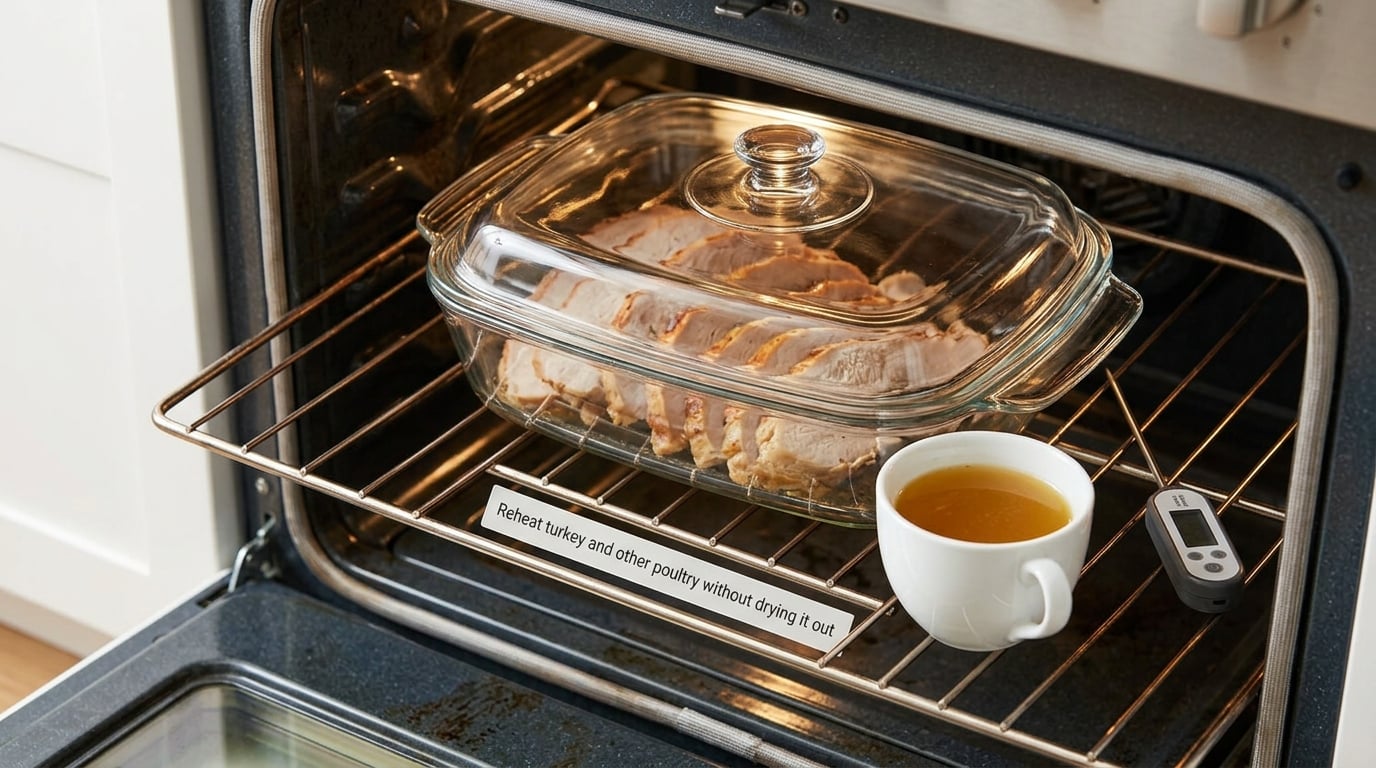
Put sliced turkey in a single layer in a baking dish, add a couple of tablespoons of broth or pan juices, and tent loosely with foil. Heat at 325F, and check the thickest pieces after about 15 minutes.
For a whole or half turkey, start at 325F with a cup of broth in the roasting pan and a loose foil tent. A very large bird needs closer to 45 to 60 minutes, and pushing the oven hotter only dries the breast before the thighs are warm.
For a quick fix on one portion, put the slices in a covered skillet with a splash of broth over medium-low heat. Turn once, then let it sit off the heat for five minutes before you serve. Cooked leftovers need to reach 165F all the way through, and the USDA recommends checking several spots rather than trusting the first reading.
Chicken breast and ham follow the same path, though ham does not need as much liquid because it holds its own juices better. Resting is not optional. A five to ten minute rest lets the juices redistribute instead of running out onto the plate the moment you carve.
5. Reheat casseroles and gratins
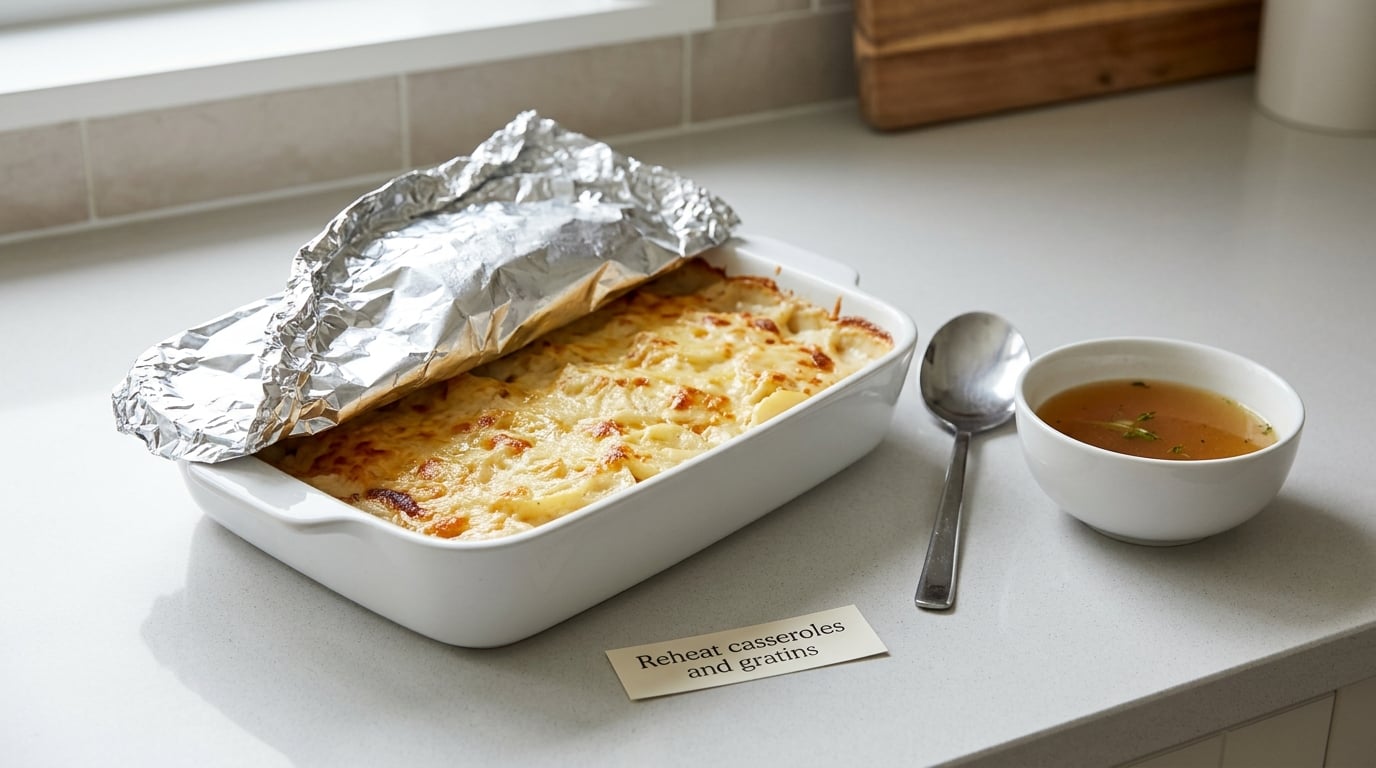
Cover the surface with foil, add two to three tablespoons of broth if the sauce looks thick, and bake at 325F. A shallow dish heats through in 20 to 25 minutes; a deep one can take twice that, which is why depth is the enemy here.
If the cheese or crumb topping has gone pale and dry, pull the dish out for its last five minutes with the foil off, or set it under the broiler for a minute or two. Watch it the whole time.
Stir halfway through a reheated casserole. Baked dishes heat from the outside in, so the edges can be loose and watery while the center is still cold. A spoon through the middle redistributes the sauce and evens out the temperature.
6. Reheat potatoes, stuffing, vegetables and gravy
These four need separate plans, because they fail in opposite directions.
- Mashed potatoes: the easiest to ruin. Put them in a covered dish with a splash of milk, butter or cream and warm on low, stirring often. The microwave at half power works too, in short bursts. High heat makes the starch turn gummy and gluey fast.
- Roasted potatoes: spread on a baking sheet, not piled in a bowl. A light coating of oil helps the outside crisp at 375F while a cup of broth in the pan keeps the oven humid.
- Stuffing: heats fast because it is already open and porous. Covered at 325F it needs 20 to 25 minutes. Uncovered it dries out within ten. A handful of broth poured over the top before covering fixes a stuffing that has already gone crumbly.
- Roasted vegetables: nearly impossible to overheat. Put them on a sheet pan at 375F for 10 to 15 minutes so the edges caramelize. Skip the foil entirely, since trapped steam turns roasted vegetables grey and soft.
- Gravy: the one item that needs the least heat and the most attention. Warm it in a saucepan over low heat with a lid, stirring often. If it thickens, whisk in broth a spoonful at a time. Do not boil it, and never use the broiler, which scorches the surface before the middle warms.
Cranberry sauce and rice work the same way. Both heat quickly and both are ruined by high heat: a couple of minutes in a covered saucepan for the sauce, and a damp paper towel over the rice in the microwave for two minutes.
7. Rest, check and serve
Turn everything off before you think about plating. Food carries on cooking after it leaves the heat, which is why an over-reheated slice keeps getting hotter while it sits on the carving board.
Push the thermometer into the thickest part of a piece of poultry, not near the bone. Check two or three different spots, since reheated food heats unevenly and the middle of a crowded dish is often the last to warm. Anything that reads cool goes back in for another few minutes.
Then look rather than just read. Gravy should be glossy and pourable. Potatoes should slump, not stand up in a spoon. Turkey should look moist at the cut edge. If the surface has tightened and gone pale, the heat has already left the food and more time will not fix it.
Common Mistakes
- Microwaving on full power. This is the single biggest cause of dry, tough reheated meat. Set it to 50 to 70 percent and work in 30-second intervals.
- Heating uncovered. Every bit of moisture that leaves the food is gone for good. Cover, always, and pull the foil back if you see condensation pooling in the dish.
- Crowding the dish. A heaped casserole takes three times as long to heat through, so it either sits in the oven until dry or never gets hot in the middle.
- Stirring too late. The edges go past done while you are dealing with something else. Turn or stir halfway, every time.
- Going too hot too fast. 425F leftovers are an order for crispy edges on food you wanted warm through the middle. 300 to 325F does the job without the tradeoff.
- Reheating everything at once. You end up with dry potatoes waiting next to cold turkey. Reheat only what you will actually eat tonight.
- Skipping the rest. Serving straight out of the oven drains the juices you worked to keep in. Five minutes changes the result.
If you host a large gathering, plan backwards from your serve time instead of cooking to order. Casseroles can go in about 30 minutes before, vegetables about 15 minutes before, and sliced turkey in the skillet at the table where you can control it. If you need the food to hold hot for a while before everyone eats, keep dishes covered at 170 to 200F rather than reheating them fully and letting them sit. The same backwards planning works if you are putting on a holiday brunch — my guide to how to make brunch for a crowd without stress covers the oven and timing side of feeding a big group.
Frequently Asked Questions
What is the best temperature for reheating holiday leftovers?
Use 300 to 325F for almost everything. That range warms a dense casserole or a turkey breast through without burning off surface moisture first. Go higher, around 375F, only when you want roasted vegetables or a crust to crisp, and never use the broiler for gravy or a whole bird.
How long do you reheat a holiday meal so everything stays hot?
Allow 15 to 20 minutes at 325F for sliced turkey and vegetables, 20 to 30 minutes for a casserole or stuffing, and 45 to 60 minutes for a whole or half turkey. Start checking early and stop the moment the center is steaming hot. Food keeps cooking after you pull it, so it rarely needs the full time.
Should I cover leftovers with foil while reheating them?
Yes, covering is what stops leftovers from drying out. A tight lid works best. With foil, tent it loosely and leave one corner open so pressure does not build and condensation does not water down your sauce. Remove the foil for the last few minutes if you want a topping to brown or crisp.
What is the safest way to reheat leftover turkey?
Use the oven or a covered skillet rather than the microwave, add a splash of broth or pan juices, and heat until steaming hot all the way through. USDA guidance puts cooked poultry leftovers at 165F, and you should check several spots with a thermometer since reheated food heats unevenly. Reheat it only once.
How do I reheat mashed potatoes and gravy without making them soggy?
Keep both on low heat with constant stirring. Mash the potatoes first so the dish is even, then stir in a splash of milk, cream or butter as they warm. Warm the gravy in a covered saucepan over low heat and thin it with broth rather than water, whisking a spoonful at a time. Neither should ever come to a boil.
Can I reheat a whole holiday meal the day before?
You can prepare the meal a day ahead, but reheat it the day you serve it. Cooked turkey and poultry will already have lost moisture once, and reheating a second time the following day pushes it further. If you want to get ahead, cook everything, refrigerate it shallowly within two hours, cover it well, and reheat once on the day.
Conclusion
If you remember one thing, start with the toughest dish and add moisture before anything else. Casseroles and potatoes go first, sliced poultry last, and every single dish gets two tablespoons of broth or pan juices and a cover before it hits the heat.
Keep the oven at 300 to 325F, check with a thermometer instead of a timer, and let everything rest a few minutes before it hits the table. That sequence is the whole difference between a holiday meal that tastes reheated and one nobody comments on.