
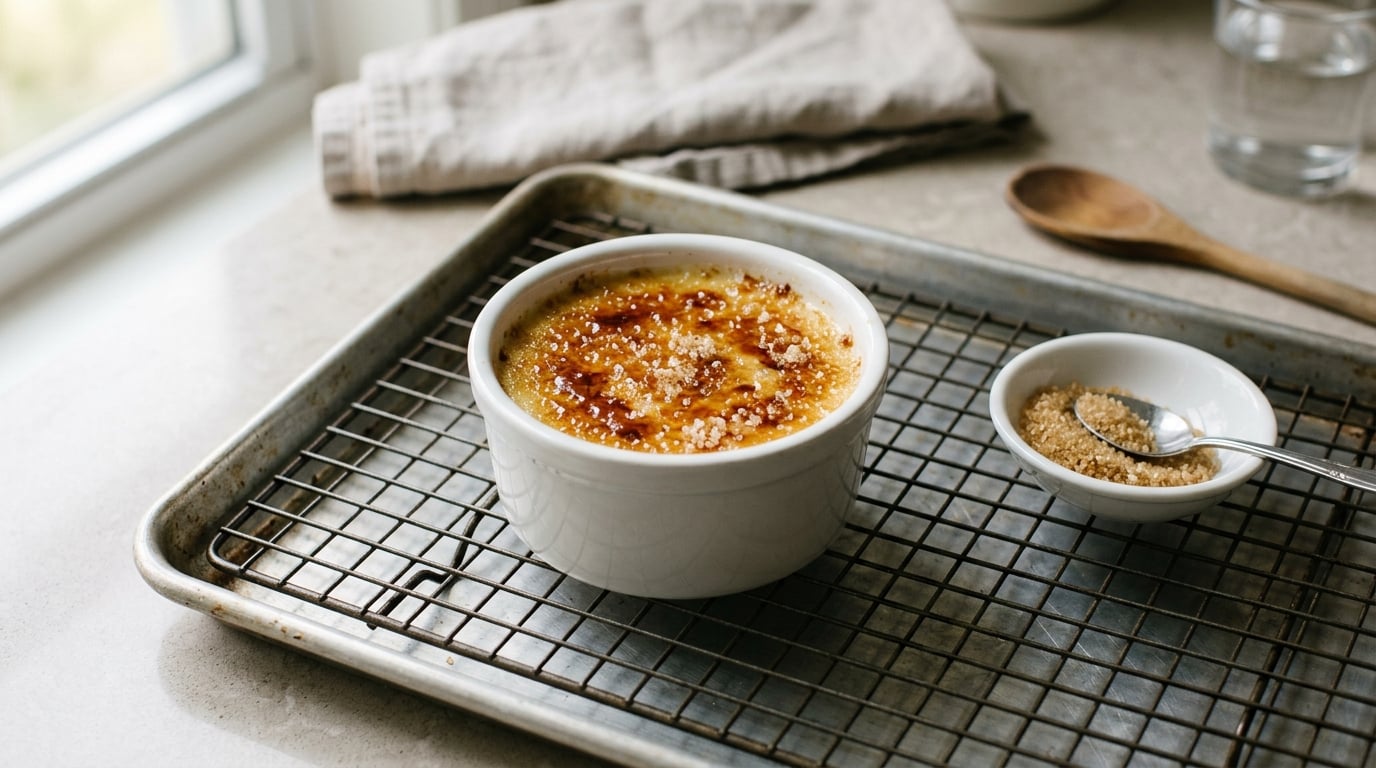
You do not need a culinary torch. To make creme brulee without a torch, sprinkle 2 to 3 tablespoons of coarse sugar over each chilled custard, set the ramekins on the top oven rack, preheat the broiler on high for 10 minutes, and broil for 1 to 3 minutes until the sugar melts to a deep amber. It hardens into the same brittle sugar crust a torch produces.
That glassy layer is called a sugar crust, and it is the whole point of the dessert: a thin brittle shell over cold vanilla custard that cracks when you tap it with a spoon. The broiler gets you there with nothing but an oven. Most of the nervousness about it comes from people who have never done it, not from anything actually difficult about the technique.
Plan on about 40 minutes of active work plus 4 hours of chilling, and treat the broil as a 2-minute job you stand and watch. The custard itself is the forgiving part. The sugar is where beginners get into trouble, and the fix is almost always in the last 30 seconds of watching.
What You Need to Make Creme Brulee Without a Torch
Four or six oven-safe ramekins, a heatproof dish or roasting pan for the water bath, an instant-read thermometer, and a broiler on your oven. If your oven has no broiler, a stovetop method at the end of Step 4 works just as well.
For the custard, you need 2 cups of heavy cream, 5 egg yolks, 5 tablespoons of granulated sugar, 1 teaspoon of vanilla, and a pinch of kosher salt. Some cooks add a splash of orange liqueur or 1 tablespoon of bourbon, which is worth it. Whole milk in place of half the cream gives a lighter body, and skim milk works too if you expect a delicate texture rather than a rich one.
A glass baking dish works in place of ramekins, and many people prefer it because there is less to wash. Two caveats: use a dish marked oven-safe, and never set a chilled glass dish straight under a broiler. That is the thermal shock problem, and more on it below.
Here is the honest comparison of your options when there is no torch on the counter.
| Method | How it works | Time under heat | Crust quality | Best for |
|---|---|---|---|---|
| Oven broiler | Radiant heat from the top element melts the sugar in place | 1 to 3 minutes | Thin and glassy, slightly softer than a torch crust | Almost everyone |
| Stovetop caramel | Sugar melted in a pan to 350F, poured over the cold custard, cools to a brittle shell | 8 to 10 minutes | Thicker, chewy, deeper amber flavor | No oven or no broiler |
| Kitchen lighter | Direct flame passed over the sugar in a sweeping motion | 30 to 60 seconds | Very close to a real torch | People comfortable handling flame |
| Heated spoon | Metal spoon held over a gas flame until it glows, then used to melt the sugar | Several minutes, slowly | Patchy and thin, unevenly colored | Last resort |
The broiler wins for most people because it is fast, even, and requires no flame in your hand. The honest drawback is that a torch heats the sugar from a point and lets you build the crust gradually, while a broiler dumps radiant heat on the entire surface at once. That is why the broiler version tends toward thinner and sometimes slightly chewy, and why a few cooks on r/food insist it can never match a torch. I think they are partly right about the texture, but the finished dessert is closer than they claim, and the broiler version is far more forgiving than a torch for a first attempt.
Step-by-Step
Step 1: Make the Vanilla Custard
Heat the cream to about 160F, just short of a simmer. You want it steaming and small bubbles forming at the edge, not boiling. While it heats, whisk 5 egg yolks with 5 tablespoons of sugar until pale and slightly thickened, about a minute by hand.
Pour the hot cream into the yolks in a slow stream while whisking. Do this off the heat, because hot cream meeting cold yolks in a direct pour is how you scramble them. Whisk the salt and vanilla in at the end.
Strain the whole mixture through a fine-mesh sieve into a jug. This one step removes the vast majority of small curd particles and is the difference between a silky custard and one with a faint graininess to it. Skim any foam off the surface.
Step 2: Bake the Custards Until Just Set
Set an empty roasting pan in the oven, put the ramekins in it, and pour hot water into the pan until it comes about halfway up the sides of the ramekins. That water bath is the whole trick to a gentle bake. Without it, the eggs coagulate unevenly and you get a rubbery center.
Bake at 300F until the center of each custard hits 165F on an instant-read thermometer, roughly 25 to 35 minutes. Look for the visual cue too: the edges bubble gently while the center only steams. Then give the pan a gentle nudge. If the surface ripples like set jelly and holds its shape, it is done. If it sloshes like liquid, give it three or four more minutes.
Take the ramekins out and let them sit on a towel for a few minutes so you do not shock the glass.
Step 3: Chill the Custards Thoroughly
Custard that is merely cool will melt the sugar you add to it. Refrigerate the ramekins uncovered for at least 4 hours, and overnight is better. Covering them traps condensation, and condensation under your sugar layer is the main reason a broiled top refuses to crack.
Before you sugar anything, let the chilled ramekins sit on the counter for 10 to 15 minutes. This is the thermal shock fix. Glass that has spent eight hours in a refrigerator plus the shock of a broiler element 4 inches above it is the single realistic way to shatter a ramekin in this process. Room temperature glass, plus a light layer of water on the outside of the dish if you are nervous, is cheap insurance.
Step 4: Add Sugar and Caramelize Without a Torch
Pull the oven’s top rack forward, set the ramekins in, and push them back so the surface of the custard sits 4 to 6 inches below the broiler element. Set the oven to high broil and let it preheat for 10 minutes with the door closed.
While the broiler preheats, scatter 2 tablespoons of sugar over each 6-ounce ramekin. Use 3 tablespoons if your broiler is powerful and you want a thick crust. A fine, even layer is the goal, not a mound, and a light sift through a sieve is the easiest way to get there.
Sugar choice matters more than most recipes admit. Demerara or turbinado, the coarse cane sugars, give a deeper flavor because the larger crystals take longer and scorch less. Granulated melts faster, so it is easier to burn, and it dissolves more readily. Brown sugar works and adds molasses depth, but it softens and never gets quite as glassy. A few bakers prefer caster or superfine sugar over coarse under a broiler because it colors more evenly.
Slide the rack in and broil for 1 to 3 minutes. Watch through the oven window and do not open the door. The sugar should go from white to a deep golden amber, bubble, and darken. The moment it passes medium gold, pull it out. The single most reported failure on cooking forums is sugar going from perfect to black in seconds, and it happens to everyone who opens the door to check. Opening drops the temperature, the sugar re-melts into a puddle instead of drying to a shell, and the crust you wanted never forms. One home cook on the Cuisine at Home forum put it plainly: do not open the oven until the time is up.
If the front ramekins are browning before the back ones, rotate the pan halfway through. Pull everything out and let the crust harden at room temperature for 1 to 2 minutes. It only sets at room temperature, so putting a broiled creme brulee back in the fridge melts the crust you just made. Serve immediately.
A note on what you are looking at, honestly. A torch gives you a thicker, more sculptural shell because it heats in a tight circle. The broiler gives you a thinner, more even amber layer that still cracks properly and tastes of burnt sugar in the way the dessert intends. I have served the broiler version to people who did not know a torch was involved, and not one of them mentioned it.
If you have no oven or no broiler: make a dry caramel in a small heavy pan. Combine 1 part sugar with a little water, melt over medium heat without stirring, and swirl the pan until the sugar hits about 350F and turns deep amber. Pour it in a thin stream over each cold custard, then wait 5 to 10 minutes until it cools and hardens. It is a slightly thicker, more chewy crust, and it leans further into burnt-sugar territory, but it needs nothing but a stovetop.
If you have a kitchen lighter: yes, it is safe, with conditions. Light it, sweep the flame in quick circles over the sugar 2 to 3 inches above the surface, and keep the flame moving constantly so you heat an area rather than drilling into it. Work in a ventilated kitchen, keep your hair and sleeves back, and never leave a burning lighter sitting on a counter. Do not use a disposable utility lighter on a dessert you plan to eat if you can help it; a refillable butane lighter is the right tool.
Common Mistakes
The sugar melted into a puddle and there is no crackle. You opened the door, the sugar was too fine, or the custard was not cold enough. Use coarse sugar, keep the custard thoroughly chilled, and give the full 1 to 3 minutes without looking inside.
The top is chewy instead of glassy. Too much sugar, or it went back into the fridge. Keep it at room temperature for a minute or two after broiling, and use 2 tablespoons rather than 3 for a thinner shell.
Half the ramekins browned while the rest stayed white. You did not rotate the pan, or the rack was too low. Pull the top rack forward and set the ramekins in before the broiler preheats so you can position them properly.
The custard is grainy, curdled, or rubbery. Either the water bath was missing or the bake ran long. The rubbery edges around the outside are the giveaway that the water never came halfway up.
The center runs out when you crack it. It was underbaked. Aim for 165F in the center and let the surface only wobble slightly rather than slosh.
Nothing forms a crust at all. You may have foil or plastic wrap still on the ramekins, or you used a dish that is too shallow for a proper layer. Both prevent the sugar from reaching the element directly.
Frequently Asked Questions
Can I make crème brûlée without a torch?
Yes, and the result is not a compromise. The oven broiler melts a layer of sugar over the chilled custard in one to three minutes, producing the same glassy crackle a torch gives you. A stovetop caramel, a kitchen lighter, or even a heated spoon can also do the job, each with a slightly different result.
Can I use an oven broiler instead of a kitchen torch?
That is the standard method in most restaurant home kitchens. Set the ramekins on the top rack four to six inches from the element, preheat on high broil for ten minutes, then broil the sugared custard one to three minutes. A broiler gives a thinner, more evenly amber crust than a torch, but it cracks the same way.
Why is my crème brûlée runny?
Almost always underbaking. Pull the ramekin at 165F in the center and check that the edges bubble while the middle only steams, then nudge the pan and look for a set jelly wobble. A missing water bath is the other common cause, since the eggs set unevenly and turn rubbery or soupy without that gentle bath.
How long should crème brûlée chill before serving?
At least four hours in the refrigerator, and overnight is better. The custard has to be genuinely cold, not merely cool, or the sugar will melt into it instead of forming a shell. Leave the ramekins uncovered so condensation does not sit on the surface, and let them warm on the counter for ten to fifteen minutes before broiling.
Can I make crème brûlée ahead of time?
Make the custard ahead and broil to order. You can bake the ramekins up to three days ahead, refrigerate them uncovered, and add the sugar and broiler step right before serving guests. Never store a crème brûlée that has already been broiled; condensation softens the crust and it will never crack again.
What sugar works best for the caramelized topping?
Demerara or turbinado. The coarse cane crystals melt more slowly, take on a deeper burnt-sugar flavor, and scorch less than granulated sugar, which dissolves and browns fast under high heat. Brown sugar adds molasses depth but stays soft rather than glassy. Use two tablespoons per six-ounce ramekin, three if you want a thick crust.
Conclusion
Start with the custard. Make it a day ahead, chill it uncovered, and let the ramekins come to room temperature so the glass is not shocked. Then broil 2 tablespoons of coarse sugar per ramekin for one to three minutes, without opening the door, and rest it on the counter until the crust hardens.
That is the whole technique. Everything else is a variation on it, and the broiler version is the one worth learning because it needs no specialty tool, takes two minutes, and produces a crackle that satisfies a spoon just as well as a torch does.