
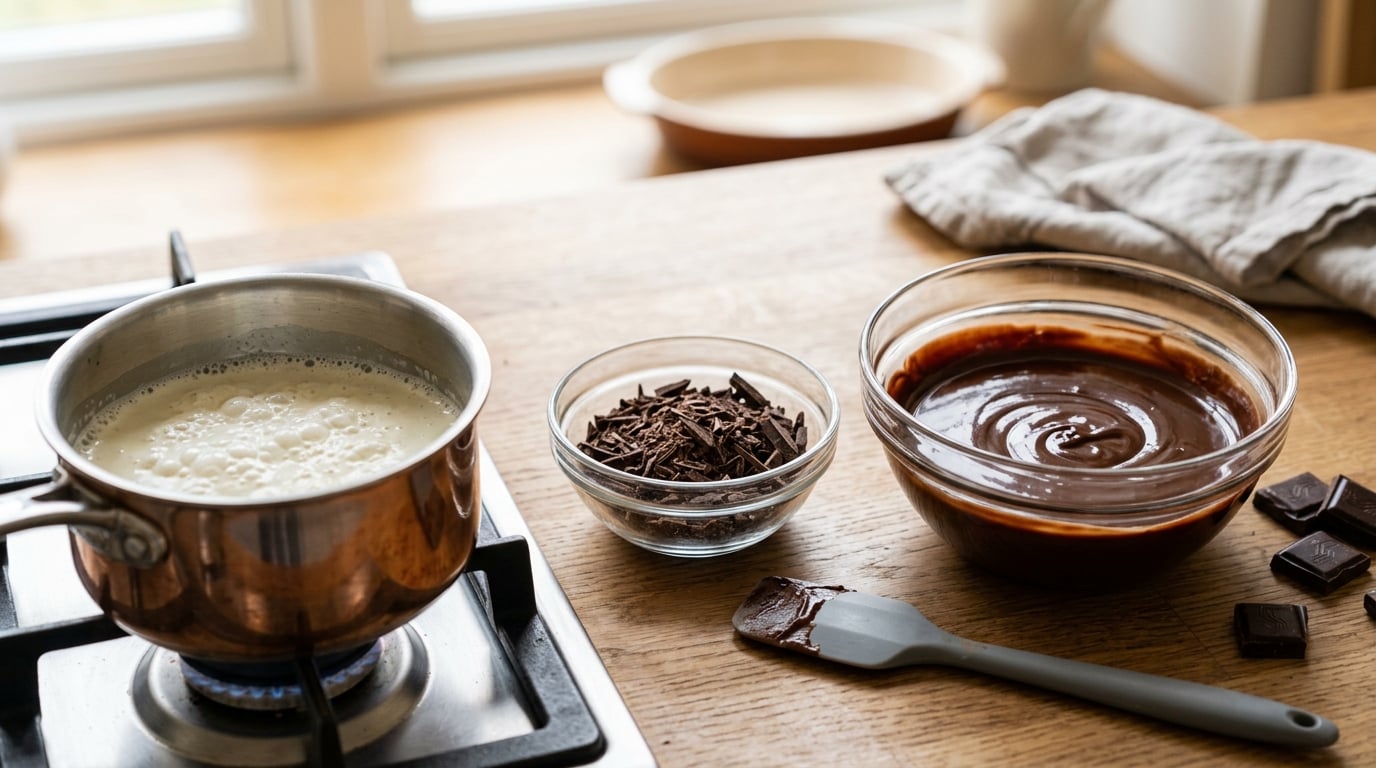
Chocolate ganache is a smooth emulsion of melted chocolate and warm heavy cream, and learning how to make chocolate ganache for desserts takes about ten minutes of active work. The classic starting point is two parts chocolate to one part cream by weight, poured together and stirred from the centre until glossy. Almost every failure people describe — curdling, graininess, a filling that slides off the cake — traces back to heat or to ratio, and both are far easier to control than the recipe cards suggest.
What follows is the method I actually use, including the temperature I aim for and the rescue that works when a batch does split. The technique is the same one that keeps an egg-yolk sauce from breaking; if you have ever fought hollandaise that splits, the logic here will feel familiar.
Table of Contents
- What You Need
- Step-by-Step
- Frequently Asked Questions
- How do I make chocolate ganache for desserts with the right ratio?
- What type of chocolate is best for making ganache?
- My chocolate ganache has split. What can I do to fix it?
- My chocolate ganache is too thin. How can I thicken it?
- Can I make ganache ahead of time and how long does it last?
- Is ganache supposed to be thin?
- Conclusion
What You Need
Ganache is two ingredients and a bowl. The part that trips people up is not the ingredient list but knowing which ratio and which chocolate they need for the dessert in front of them.
The two core ingredients
- Chocolate, by weight. Semisweet or bittersweet bar chocolate works best, chopped into even 1 cm pieces so it melts at the same rate. Couverture is the professional version of the same thing and gives a cleaner, shinier result. Chocolate chips work, but they contain stabilisers and less cocoa butter, so the ganache sets firmer and gloss is harder to achieve.
- Heavy whipping cream, about 35 percent fat. The fat is what suspends the cocoa solids. Light cream or single cream will not hold the emulsion, and any cream you use should be unsweetened and free of stabilisers.
Weigh both. Volume measures are the single biggest reason two people follow the same recipe and get different results, because a cup of chopped chocolate and a cup of grated chocolate do not weigh the same.
The basic ganache formula by chocolate type
Use this as the starting point, then adjust for the consistency you need. Ratios are chocolate to cream by weight.
| Chocolate | Chocolate to cream | Example for 200 g chocolate | Typical use |
|---|---|---|---|
| Dark or bittersweet (60 to 70 percent) | 2:1 | 100 g cream | Filling, glaze, truffle base |
| Milk chocolate | 2.5:1 | 80 g cream | Frosting, tart filling |
| White chocolate | 3:1 to 4:1 | 50 to 65 g cream | Filling, pouring cream |
White chocolate is the exception people get wrong most often. It holds far less cocoa butter, so it needs noticeably more chocolate and much less liquid to reach a pourable or pipeable texture. Many home bakers end up at 3:1 and still find it thinner than expected, which is normal rather than a mistake on your part.
Which consistency do you actually need?
The same base recipe covers everything from a thin drizzle to a filling that holds a piping bag. Aim for the result, not the recipe name.
| Target | Look for this texture | Adjust from 2:1 by |
|---|---|---|
| Thin drizzle or glaze | Runs off the spoon in a ribbon | Add 25 to 50 percent more cream |
| Cake filling | Thick, spreads but holds its shape | Keep 2:1, or reduce cream slightly |
| Pipeable frosting | Stiff enough to hold a ridge | Cut 25 percent of the cream, or cool it fully first |
| Dipping fruit | Coats and firms up within an hour at room temperature | Use 2:1, then test one piece before the batch |
| Truffle base | Thick paste, no flow at all | Halve the cream and chill |
Optional additions and swaps
- Butter or neutral oil adds body and a softer shine, roughly 1 tablespoon per 200 g of chocolate. Skip it for a clean, light filling.
- Espresso powder does not make a ganache taste like coffee. It deepens the cocoa flavour, which is why pastry chefs use it in everything from truffles to glaze.
- Liqueur, extract or spices. Orange liqueur, rum, peppermint extract, smoked salt, cinnamon or chili all dissolve in. Add salt in tiny pinches and taste before adding more.
- Dairy-free. Full-fat coconut cream heated to the same temperature works in the same ratios for a coconut note. A neutral oil such as grapeseed replaces cream entirely in a one-pour glaze, but that method is looser, softer and does not set the way a cream ganache does.
Equipment
A heavy-bottomed saucepan, a heat-safe bowl that sits on its rim without touching the water, a sharp knife and a cutting board, and a silicone or offset spatula. A digital thermometer is the single most useful optional tool here, because it turns “bring to a simmer” into a number you can hit twice in a row.
Step-by-Step
How to Melt the Chocolate and Warm the Cream
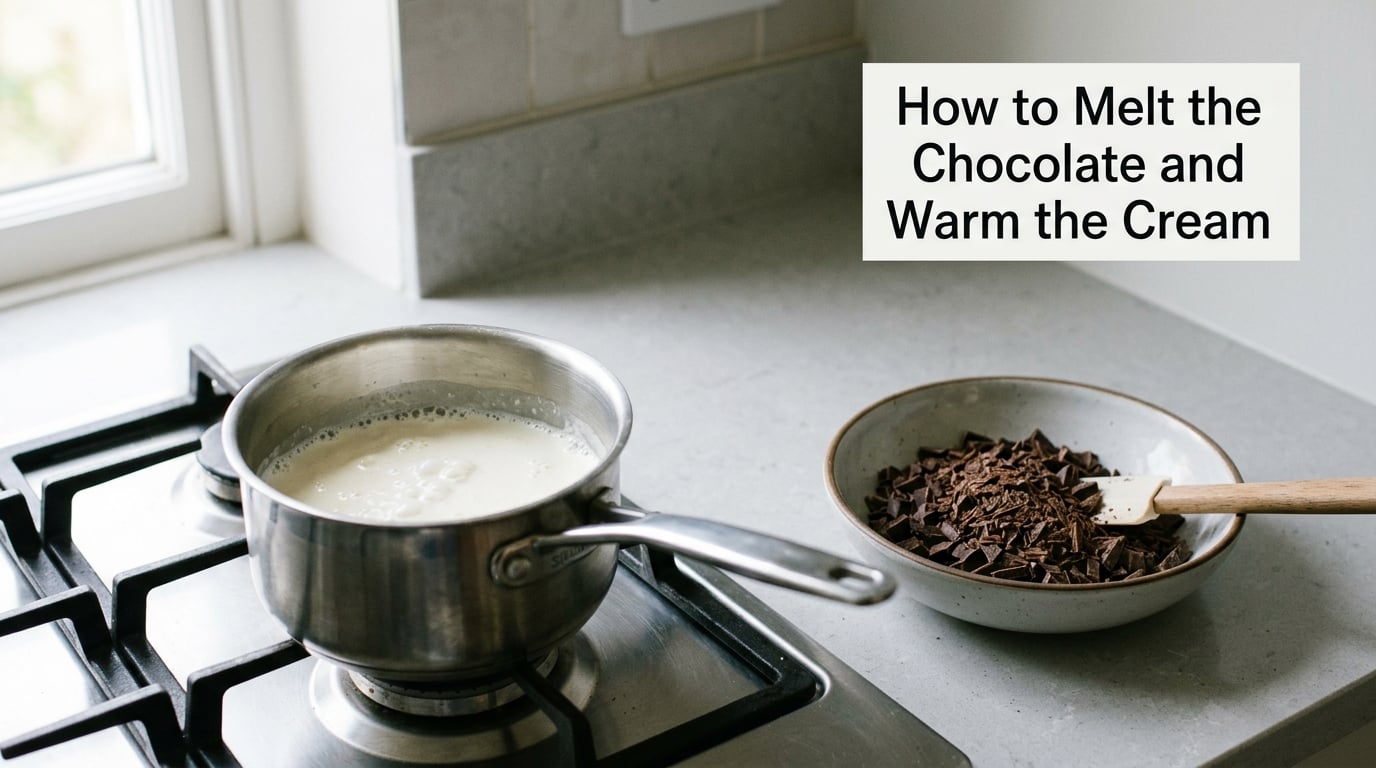
Chop the chocolate finely and put it in your heat-safe bowl. Fill the saucepan with an inch or two of water and set the bowl on top so the bottom of the bowl never touches the water. That gap is the whole point of a bain-marie.
Warm the cream in a separate saucepan and watch for the first small bubbles forming around the edge of the pan, not a rolling boil. If you have a thermometer, pull it off the heat at 175 to 180 F (79 to 82 C). That is hot enough to melt the chocolate without shocking it.
While the cream heats, chop the chocolate. A microplane gives the fine, even shavings that melt fastest, and a knife gives you more control. Either works; what matters is that the pieces are small enough to disappear in about a minute once the cream lands on them.
How to Combine the Chocolate and Cream
Pour the warm cream over the chopped chocolate and wait a full minute without touching it. Cover the bowl if you like. That rest lets the heat travel into the chocolate on its own, which is far gentler than trying to force it with a spoon.
Now whisk, starting at the very centre of the bowl and working outward in slow circles. The middle is where you will see thick, paste-like streaks first, and that is the part that needs the focused stirring. Scrape the sides as you go.
Keep the whisking slow and steady. Beating fast drags in air, and air is exactly what gives a finished ganache that dull, matte skin instead of a mirror finish.
How to Make the Ganache Smooth and Glossy
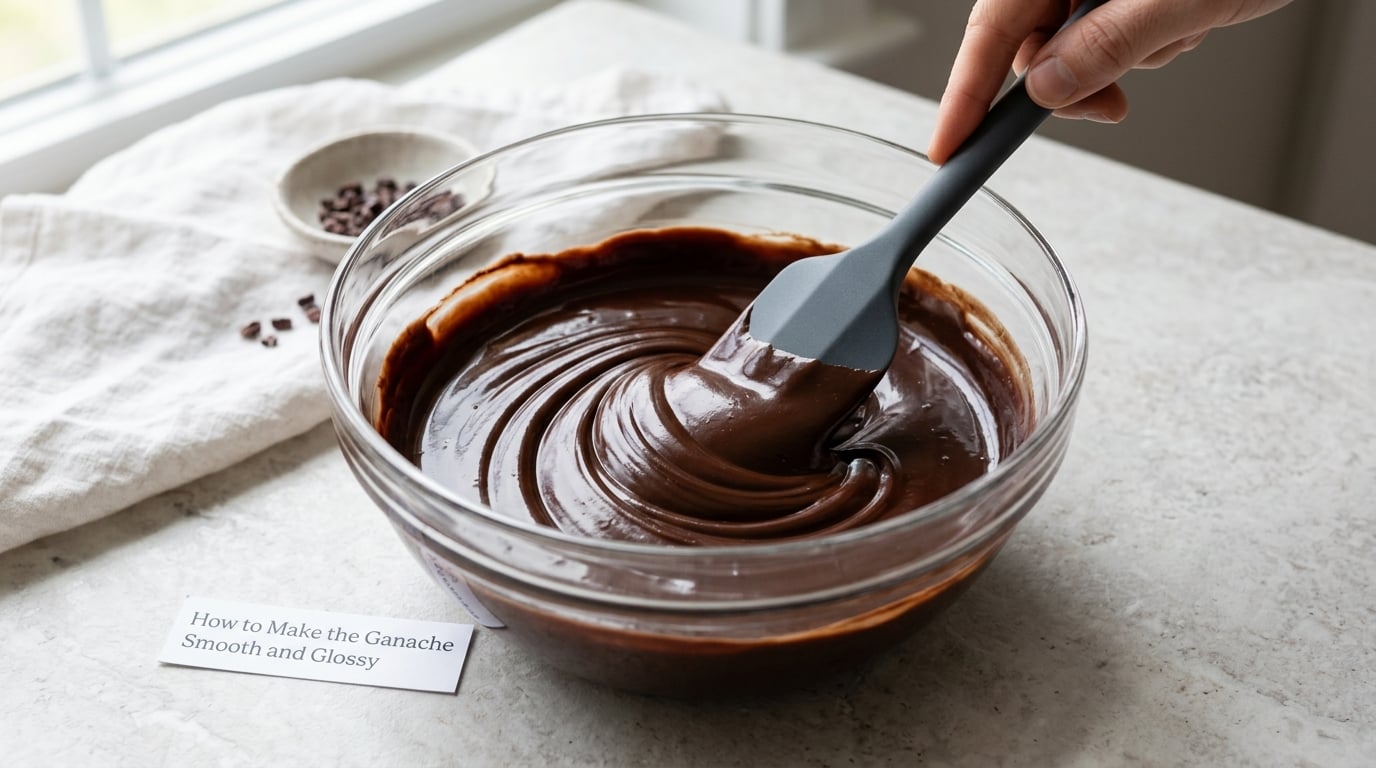
Push the spatula firmly against the bowl wall and fold rather than stir. This forces small remaining bits of chocolate against the warm surface, where they dissolve instead of floating. By the second minute the mixture should pull away from the bowl cleanly.
You are looking for a surface that reflects light like wet paint, with no graininess visible when you tilt the bowl. If tiny specks remain, an immersion blender held just under the surface for ten seconds will catch them. As a last resort, pass the whole batch through a fine sieve.
Gloss comes from three things: not over-whisking, not letting water into the bowl, and not letting the chocolate scorch. It also fades over hours as the fat continues to set, so a ganache that looks mirror-bright at minute five is at its best at minute five.
How to Cool, Thicken, and Store the Ganache
A pourable ganache is ready to use straight away. A filling or frosting usually needs twenty to thirty minutes at room temperature, and a piping frosting needs a short chill, about fifteen minutes, so the fat firms up enough to hold shape.
Press plastic wrap directly against the surface of any ganache you are not using immediately. Skin forms on contact with air, and that skin is the first thing that goes grainy.
Covered, ganache keeps about two days at cool room temperature, up to a week refrigerated, and roughly three months frozen in portions. If it has set hard, warm it gently over a bain-marie and whisk, adding a tablespoon of cream only if it needs loosening. Never microwave a stiff ganache; the uneven heating is what causes the grainy texture you were trying to avoid.
Making it a day ahead is usually a good move, especially if you are also cooking brunch for a crowd and juggling three other things. Reheat gently and re-gloss with the smallest possible splash of warm cream.
Common Mistakes
Every one of these is recoverable, including the ones that look worst.
- Split or curdled ganache. The fat and water in the cream have separated. Set the bowl over barely simmering water, add a tablespoon of warm cream, and whisk hard and fast. It usually comes back within a minute. If it stays broken, blend it with an immersion blender or whisk in a few small ice cubes, which shocks the fat back into suspension.
- Seized chocolate, thick and clumped. A drop of water, cream or even one stray drop from the sink flipped the cocoa butter. Add a tablespoon of warm cream and keep stirring; the clumps loosen into a stiff paste before they loosen again.
- Grainy or seedy texture. Usually a heat problem, not a ratio problem. Some chocolate got too hot and the fat crystals never re-dissolved. Warm the batch gently with a splash of cream and whisk, or blend it.
- Ganache too thin to fill a cake. Two causes: too much cream for the chocolate, or a cake too warm to hold it. Fix the first by reducing nothing and instead chilling the ganache, or by adding a little more chopped chocolate to a warm batch. For the second, let the cake cool completely first.
- Ganache too stiff to pipe. Warm it over a bain-marie, not in the microwave, and add warm cream a tablespoon at a time until a ribbon falls off the spatula.
- A dull, matte finish. You over-whisked it. Beat in a spoonful of warm cream at the end to relax the trapped air, and stop stirring as soon as the colour deepens.
Two habits fix most of the rest. Weigh rather than scoop, and never boil the cream. Boiling is the single most reported cause of splitting, and a rolled boil takes about ten seconds longer to fix than it does to avoid.
Frequently Asked Questions
How do I make chocolate ganache for desserts with the right ratio?
The basic formula is chocolate to heavy cream by weight: 2:1 for dark or bittersweet chocolate, 2.5:1 for milk chocolate, and 3:1 to 4:1 for white chocolate. That means 200 g of dark chocolate gets about 100 g of cream. Weigh rather than scoop, warm the cream to 175 to 180 F, pour it over chopped chocolate, wait a minute, then whisk from the centre outward.
What type of chocolate is best for making ganache?
Semisweet or bittersweet bar chocolate gives the best balance of sweetness and depth, and couverture gives the smoothest, shiniest result. Chocolate chips do work, but their added stabilisers make the ganache set firmer and the surface duller. Whatever you use, chop it finely and weigh it, and stay away from compound chocolate, which contains no cocoa butter at all.
My chocolate ganache has split. What can I do to fix it?
Split ganache is recoverable. Set the bowl over barely simmering water, add a tablespoon of warm cream, and whisk hard and fast until the mixture comes together, usually within a minute. If it is still broken, blend it with an immersion blender, or whisk in a few ice cubes to shock the separated fat back into suspension. The cause is almost always cream that was boiled or poured too fast.
My chocolate ganache is too thin. How can I thicken it?
You have two options, and chilling is usually the better one. Cover the surface with plastic wrap and refrigerate for twenty to thirty minutes, then stir; cold fat firms up without changing the flavour. If you need it thicker immediately, warm a little extra cream, stir it into the ganache off the heat, and let it cool again. For a cake filling, make sure the cake is completely cool first.
Can I make ganache ahead of time and how long does it last?
Yes, and it usually improves overnight. Press plastic wrap directly onto the surface so no skin forms. Covered, it keeps about two days at cool room temperature, up to one week in the fridge, and around three months frozen in portions. Reheat it gently over a bain-marie and whisk, adding cream a little at a time only if it needs loosening.
Is ganache supposed to be thin?
It depends what it is for. A finished ganache should be glossy, smooth and noticeably thicker than the cream it started as, but a thin ribbon off the spoon is correct for a glaze, a drizzle or a fruit dip. A cake filling should spread but hold its shape, and a piping frosting should hold a ridge. If a recipe says only the word ganache, judge the texture you need rather than the name.
Conclusion
Start with 200 g of semisweet chocolate and 100 g of heavy cream, both weighed. Chop the chocolate, warm the cream to 175 to 180 F, pour, wait a minute, then whisk slowly from the centre until the bowl looks wet and glossy. That single batch covers a drizzle, a filling and enough for a dozen truffles, and once you have made it twice, adjusting the ratio is easier than the recipe makes it sound.
One last note for serving: ganache is a finishing element rather than a course on its own, and it pairs best when something salty or acidic sits next to it. If you are building a cheese and dessert spread, our beginner cheese board guide has the same logic in reverse.