
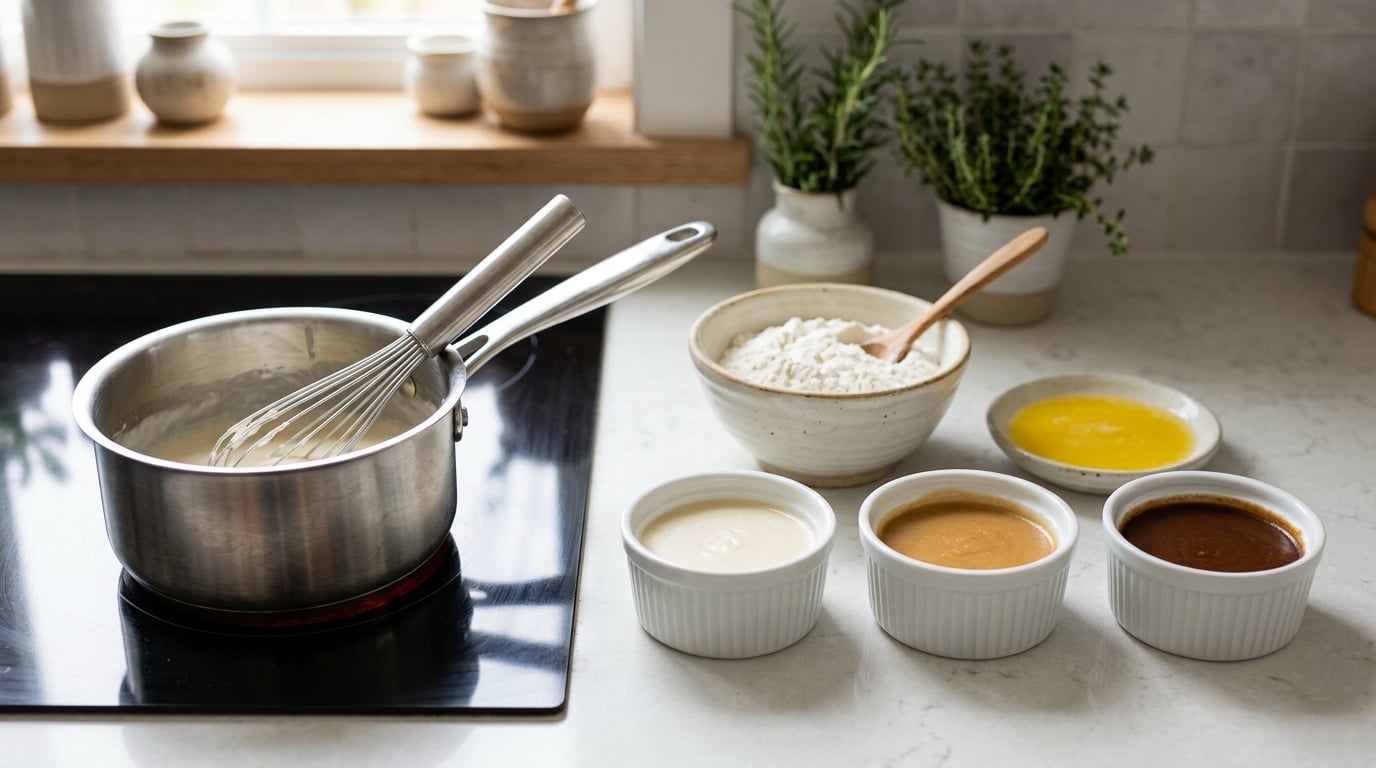
How to make a roux for sauces comes down to one rule: cook equal parts fat and flour until you hit the color you want, then whisk in your liquid slowly. That is the whole technique. Ten minutes of work and you have the base for béchamel, cheese sauce, gravy, gumbo and chowder.
Roux is a paste of flour cooked in butter or oil, and it is the oldest trick in a restaurant kitchen for thickening a liquid without the raw, gluey taste that plain flour leaves behind. The fat coats each starch granule so the flour disperses instead of clumping, then the heat cooks off the raw flour smell. It takes one pan, a whisk and a measuring cup, and beginners usually get it right on the second or third try.
The whole job runs about ten minutes, most of it standing at the stove whisking. If you are making it inside a bigger dish, like a gumbo, set the roux up first and cook it before you touch the trinity of onion, celery and bell pepper.
What You Need
You need two ingredients in equal measure, one pan, and a whisk. Equal parts is the formula behind every roux, from the palest white sauce to the dark brown base of a Cajun gumbo.
- Fat: unsalted butter for white and blonde roux, clarified butter or neutral oil once you are heading past brown
- Flour: all-purpose flour, measured
- Liquid: milk, cream or stock, ready and warmed
- Equipment: a heavy-bottom saucepan, a whisk, a rubber spatula and a kitchen scale if you have one
Weighing beats spooning when you can. Volume measurements drift because a heaped tablespoon of flour and a level one are not the same weight, and that difference decides whether your sauce ends up silky or gluey. A tablespoon of all-purpose flour is roughly 8 grams, so 60 grams of flour pairs with 60 grams of butter, a level stick of butter cut into cubes. If you have no scale, level cups and spoons, and do not pack the flour down.
How much roux per cup of liquid
Published ratios disagree all over the place, mostly because people are guessing at what counts as thick. Here is the table I cook by, where the fat and flour are always equal to each other.
| Result you want | Fat | Flour | Liquid |
|---|---|---|---|
| Light coating, good for a cream soup | 1 tbsp | 1 tbsp | 1 cup |
| Medium sauce, the everyday pour | 2 tbsp | 2 tbsp | 1 cup |
| Thick gravy that holds a spoon | 3 tbsp | 3 tbsp | 1 cup |
| Two cups of finished gravy, worked backward | 4 tbsp | 4 tbsp | 2 cups stock |
That middle row is the standard white sauce ratio, and it is the one the search results keep circling: two tablespoons butter, two tablespoons flour, one cup milk. Salt and pepper at the end. Memorize that row and you can build anything.
Step-by-Step
Step 1: Measure the Fat and Flour
Measure before you turn on the heat, because once the butter starts moving you will be whisking instead of measuring. Set the fat and the flour out side by side and check them against each other, level spoon for level spoon or gram for gram.
The same basic ratio handles every color. Nothing changes between a white roux and a dark one except how long you cook it and which fat you picked. That is worth repeating, because it is the bit people overthink.
Step 2: Melt the Fat Gently
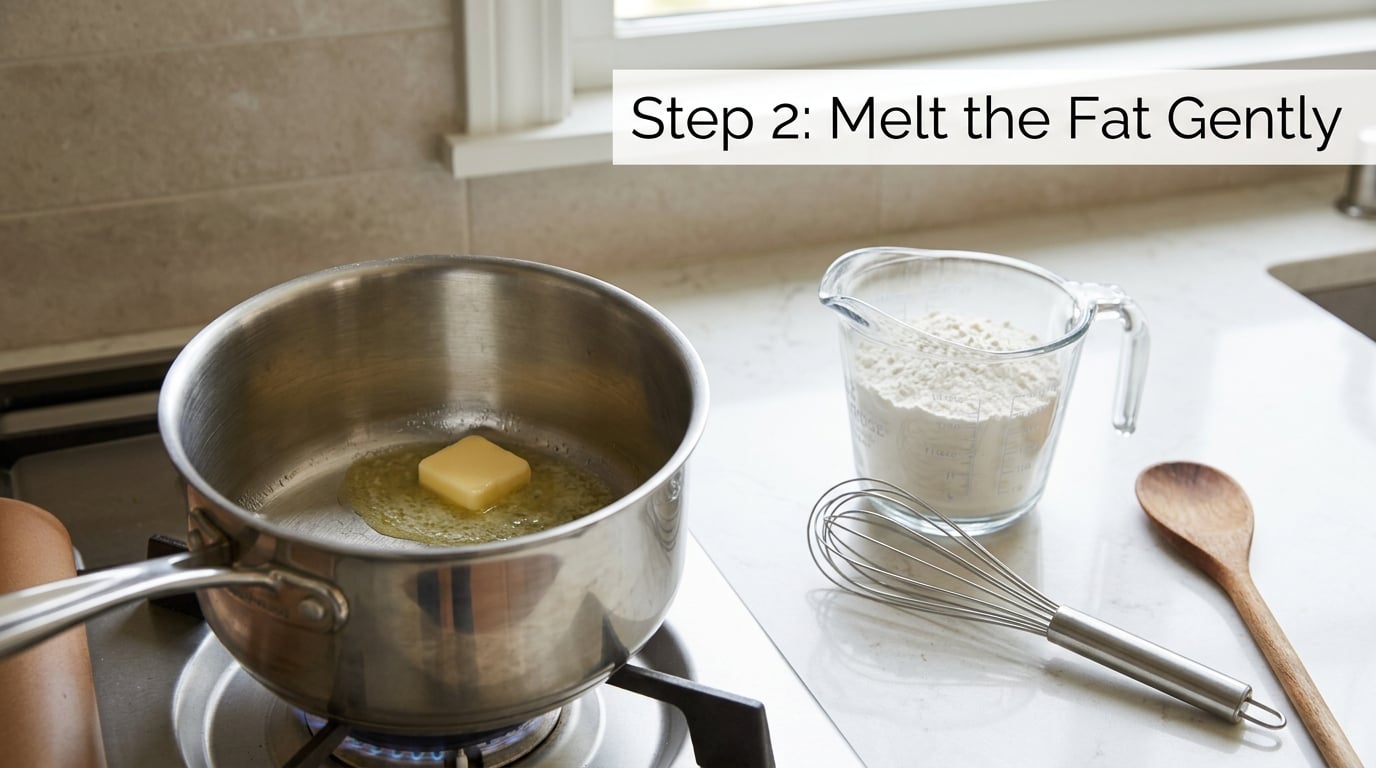
Melt the fat over medium or medium-low heat until it is fully liquid and foamy, not browned. For butter you are waiting for the milk solids to foam and turn faintly golden at the edges, roughly a minute and a half in a small pan.
If it starts smoking or smells like toasted nuts before the flour goes in, the pan was too hot. Pull it off the heat, let it settle, and restart on low. A hot pan plus hot fat plus cool flour is the fast route to a scorched roux, and scorched roux has to be thrown out.
Step 3: Add the Flour and Whisk Smoothly
Add the flour all at once and start whisking immediately. The first thirty seconds are the messiest: the mixture will clump and look like wet sand. Keep the whisk moving in small tight circles, scraping along the bottom and into the corners of the pan where the paste likes to hide.
Cook this paste for at least two minutes, three if the fat was butter and you want no raw taste at all. You are doing two jobs here. The flour loses its chalky, raw edge, and the starch granules swell slightly and get coated, which is what keeps the sauce smooth later.
The paste should look dry-ish and matte at this point, almost like soft cookie dough, and it should not be loose and drippy. If you drag a finger through the pan, the trail should hold its shape for a second or two.
Step 4: Cook to the Color You Need
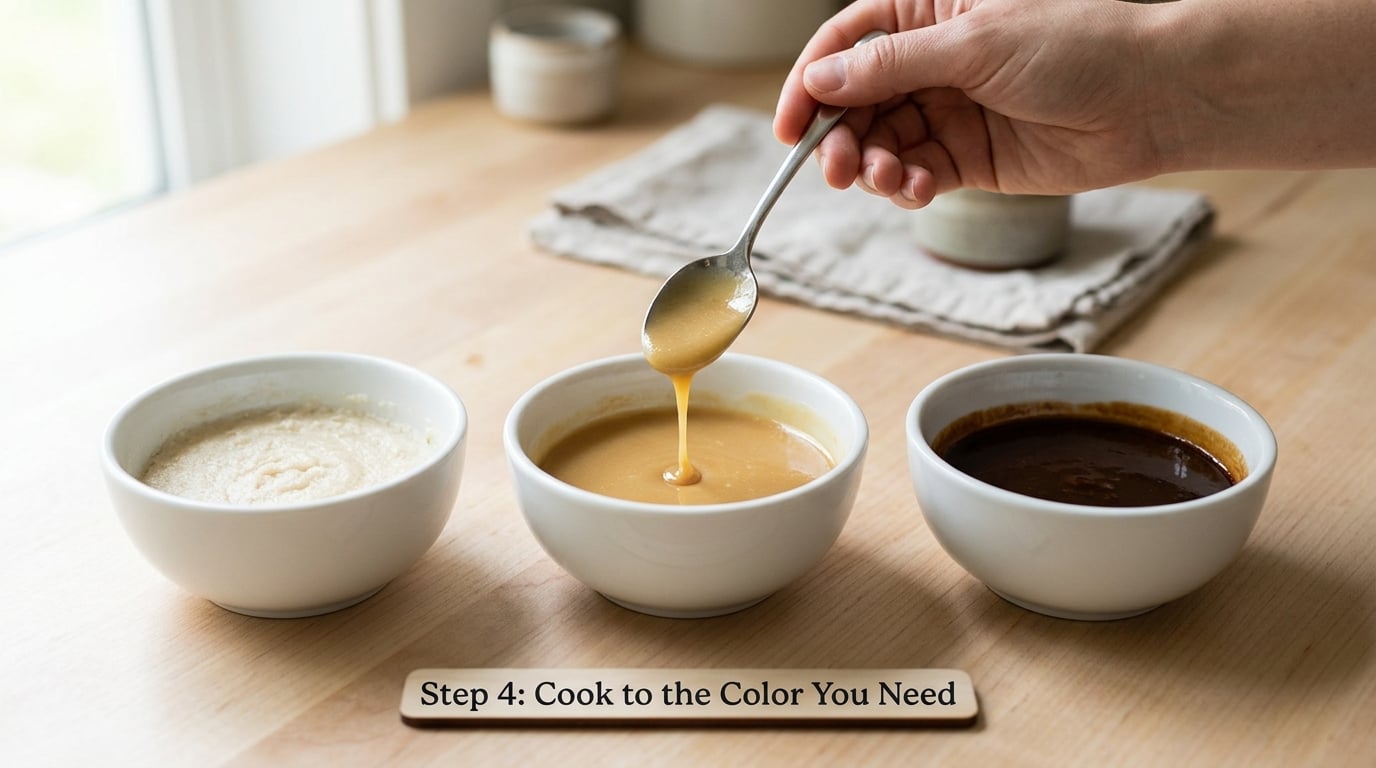
Color is the timer that does not lie. Published dark-roux cooking times range from eight minutes to forty-five depending on the author, the pan and how much you stir, so use your eyes and nose instead of a stopwatch.
| Roux | Cook time after flour goes in | What it smells like | Thickening power | Best for |
|---|---|---|---|---|
| White | 2 to 3 minutes | Faintly toasty, almost no aroma | Full | Béchamel, cheese sauce, white soup |
| Blonde | 3 to 5 minutes | Toasted flour, a hint of nuttiness | Full | Creamy soups, pan sauces, potato dishes |
| Brown | 8 to 15 minutes | Clear nutty aroma, the color of a peanut | Slightly reduced | Gravy, espanol[e], étouffée |
| Dark | 20 to 35 minutes | Deep roasted, almost coffee colored | Noticeably reduced | Gumbo, dark stews |
Here is the trade most guides skip: long cooking cooks off flavor but weakens thickening power, because extended heat slowly breaks the swollen starch down. A dark Cajun roux is looser than a white one of the same ratio, so if you are cooking a gumbo and want it to hold, either add a little more roux at the end or let the pot simmer down to the consistency you want before serving.
Switch the fat as you go darker. Whole butter will scorch before a roux reaches coffee brown, so from the brown stage onward use clarified butter, ghee, lard or a neutral oil, and keep the heat a touch lower.
Step 5: Use the Roux to Make a Sauce
Warm your liquid first. Milk or stock straight from the fridge hits the hot pan, drops the temperature sharply and thickens the paste into rubbery blobs. Warm, not boiling, is the target.
Pour in about a quarter of the liquid and whisk hard until the roux absorbs it completely. Add the next quarter, whisk, and keep going. The paste loosens a little more with every addition, and by the last pour you are whisking something that looks like thin cream.
Bring the sauce to a bare simmer and cook it two to five minutes, stirring now and then. That simmer is where the starch finishes swelling and the sauce reaches its final thickness. Taste, add salt, and add more liquid if it went too thick. A splash of warm stock loosens it faster than whisking harder does.
A finished roux sauce is a thickening base, not an emulsion. If you want the glossy, unbroken texture of a hollandaise sauce that does not break, you are working with egg yolks and temperature control instead, not with starch. And if you are serving your gravy over restaurant style mashed potatoes, make the gravy a little looser than looks right in the pan.
Common Roux Mistakes and How to Fix Them
Why is my sauce lumpy?
Lumps form when liquid hits a hot roux all at once, and the outside of each clump sets before the water gets inside. There is no way to whisk them out mid-cook, so prevention is the real fix: add liquid in four or five additions, keep the heat low, and scrape the bottom of the pan every time you pour.
If a finished sauce is already lumpy, pass it through a fine mesh strainer, or blend it for a few seconds with an immersion blender. Both rescue béchamel and white sauce without starting over.
Why does my sauce taste like raw flour?
The paste did not cook long enough, or the heat was too low to cook it evenly. Two to three minutes of real cooking fixes it. Another fix is to let the finished sauce simmer a few extra minutes, which cooks off more of that raw edge.
A grainy, sandy texture is a different problem. It means the starch granules never fully hydrated, usually because the sauce was added cold or you rushed the whisking at the beginning.
Why did my roux burn?
Burnt roux cannot be fixed. It tastes bitter and faintly acrid, and no amount of liquid or seasoning hides that. Scraping the pan and starting again with fresh fat and flour takes two minutes and saves the dish.
To stop it happening, keep the heat at medium or below, stir more often the darker you go, and use a fat with a higher smoke point once you pass brown.
Why does my sauce look right in the pan but run thin when I serve it?
Roux-thickened sauces thicken as they cool, so a sauce that looks perfect on the burner is usually right at table temperature. The reverse problem is more common though: a sauce that looked thin in the pan has not finished thickening because it was not simmered long enough. Give it two to five minutes at a bare simmer and stir.
Thickening power also drops as the roux cooks darker, so a long-cooked brown roux needs a little more of it than the numbers suggest.
My cheese sauce curdled. Can I fix it?
Curdled cheese is a heat problem, not a whisking problem. Dairy proteins seize when they get too hot too fast, so the milk needs to be warm rather than steaming, the cheese goes in off the heat in small handfuls, and the sauce gets stirred constantly rather than left sitting.
Once it has broken, take the pan off the heat and whisk in a tablespoon or two of cold milk or cream. That often pulls it back together. If it stays broken and grainy, the honest answer is to start a new batch, and to keep the heat lower next time.
Frequently Asked Questions
What is the formula for a roux?
Equal parts fat and flour, measured by weight if you have a scale. Two tablespoons of butter with two tablespoons of all-purpose flour makes one cup of medium-thick sauce. Cook the paste two to three minutes for a white roux, longer for brown, then whisk in warm liquid a quarter cup at a time.
Is it better to use oil or butter when making a roux?
Butter for white, blonde and light brown roux, because it adds flavor and the milk solids brown nicely. Oil or clarified butter for dark roux and gumbo, since whole butter burns before the paste reaches coffee brown. Ghee and lard sit in between, tasting more than a neutral oil and holding heat better than butter.
How long should I cook a roux before adding the liquid?
Two to three minutes for a white roux, three to five for blonde, eight to fifteen for brown and twenty to thirty-five for a dark Cajun roux. Judge by color and aroma rather than the clock, since stirring frequency and pan size change the timing. Any roux needs at least two minutes to cook off the raw flour taste.
Why is my roux lumpy and how do I fix it?
Liquid hitting a hot roux all at once sets the outside of each clump before the middle softens. Add warm liquid in four or five additions, whisking fully between each. If the sauce is already lumpy, strain it through a fine mesh sieve or blend it briefly with an immersion blender to break the lumps down.
Can I make roux ahead of time and store it?
Yes. Cool it fully, cover it airtight and refrigerate for up to about five days, or freeze it in ice cube tray portions for up to three months. Drop a cube into a simmering stew or pan sauce and whisk until it dissolves. Reheat gently on the stove rather than in a microwave, which can make the paste grainy.
What is the difference between a roux and a cornstarch slurry?
A roux is flour cooked in fat, which adds body and flavor but takes a few minutes. A slurry is cornstarch or flour whisked into cold water first, which thickens in under a minute and leaves a glossier, more translucent finish. Roux suits gravy, gumbo and béchamel, while a slurry is better when you need speed or a clear glaze.
Conclusion
Start by weighing two tablespoons of flour and two tablespoons of butter, melting the fat gently, and cooking the paste two to three minutes before any liquid goes near it. Equal parts, low heat, and liquid added a quarter cup at a time with the whisk moving the whole time.
Once you have that down, the only variable left is color, and color is just flavor. Cook it longer for a nuttier, darker sauce with slightly less thickening power. Learn how to make a roux for sauces once and every béchamel, cheese sauce and gumbo after it comes together faster than you expect.