
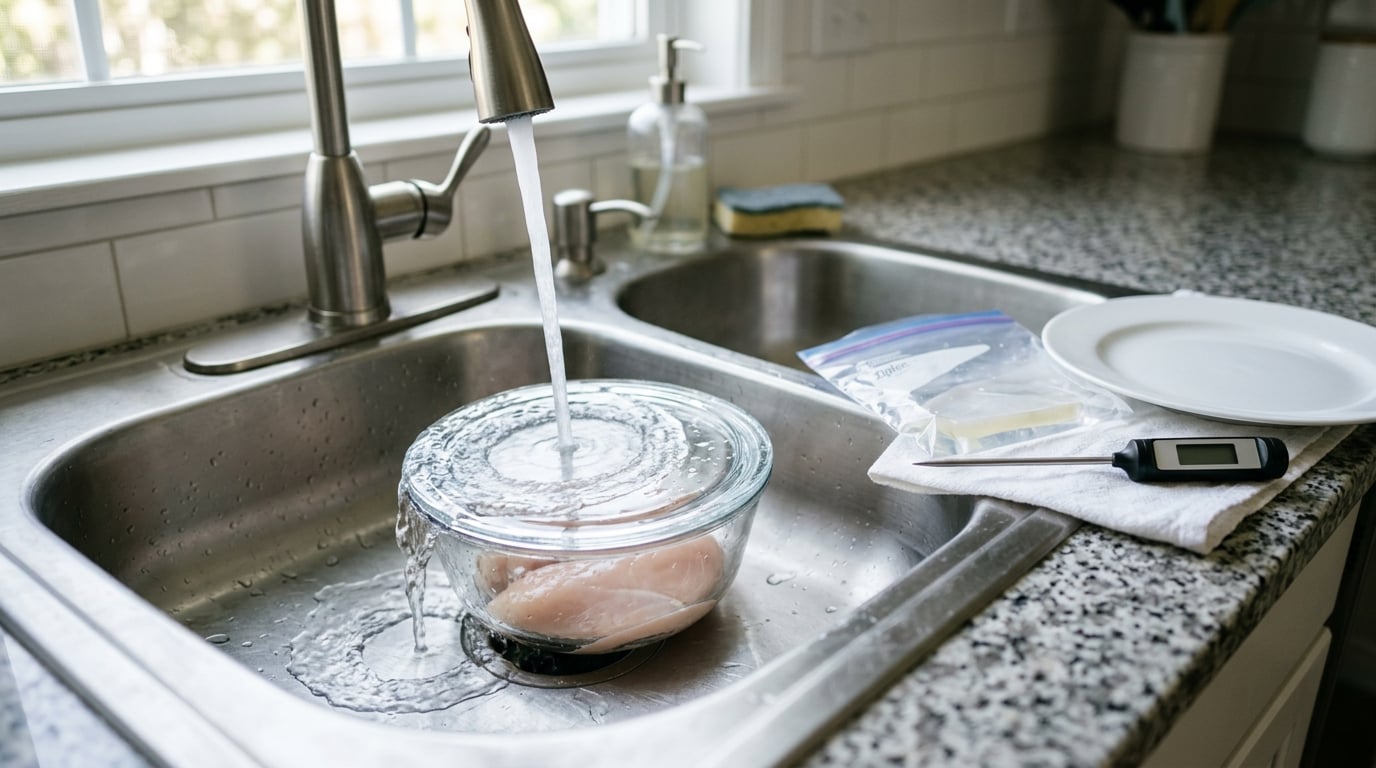
Learning how to defrost chicken safely and quickly comes down to one rule: keep the meat below 40°F the whole time, or cook it the moment it thaws. The refrigerator is the safest method and takes 24 to 48 hours. Cold water is the fastest safe method at about 30 minutes per pound. The microwave is quicker still, and only works for small pieces.
Here’s the honest version of what that means for a Tuesday night dinner. Plan ahead and the fridge handles it with zero effort. Didn’t plan and need chicken in the next hour? Cold water. Cooking a single small breast right now? The microwave, then straight into a pan.
All three methods work because they control heat transfer differently. The key part is keeping raw poultry out of the danger zone between 40°F and 140°F, where Salmonella and Campylobacter multiply fast.
What You Need to Defrost Chicken Safely and Quickly
You need very little. A cold-water method needs a leak-proof bag or sealed container, a large bowl or your sink, and cold tap water. A refrigerator thaw needs a plate or shallow tray to catch drips and the coldest part of your fridge.
A microwave thaw needs a microwave-safe plate and the defrost setting or 30% power. For checking doneness later, an instant-read thermometer is the single most useful tool in this whole process, since it removes all the guesswork.
Useful extras: a cutting board, a clean towel, and colander. Skip the idea of rinsing raw chicken. That splash spreads bacteria across your sink, and it does nothing to clean the meat.
Step-by-Step: How to Defrost Chicken Safely and Quickly
The methods below run from safest and slowest to fastest and least forgiving. The order matters because each one gives you less margin for error than the last.
Refrigerator Method: The Safest Way
Put the chicken in its original wrapping or a sealed bag, then set it on a plate or tray on the bottom shelf of the fridge. The bottom shelf is coldest, and the tray stops juices from dripping onto produce below.
Allow about 24 hours for a whole chicken weighing 4 to 5 pounds. Boneless skinless breasts usually thaw in 12 to 24 hours, thighs in 24 to 36, and wings in about 12 to 24.
Keep your fridge at 40°F or below. If you can slide the tray to the back without touching the cooling plate, do that, since the back stays coldest.
Thawing in the fridge is the only method that gives you a wide safety window. Because the meat never rises above 40°F, you can cook it later that day or even the next one.
Cold-Water Method: How to Defrost Chicken Fast Without Warm-Water Risks
Seal the chicken in a leak-proof bag. Zip it fully, or push out the air and seal it double if it will not close, because waterlogged chicken loses flavor and any leak carries raw juices into the sink.
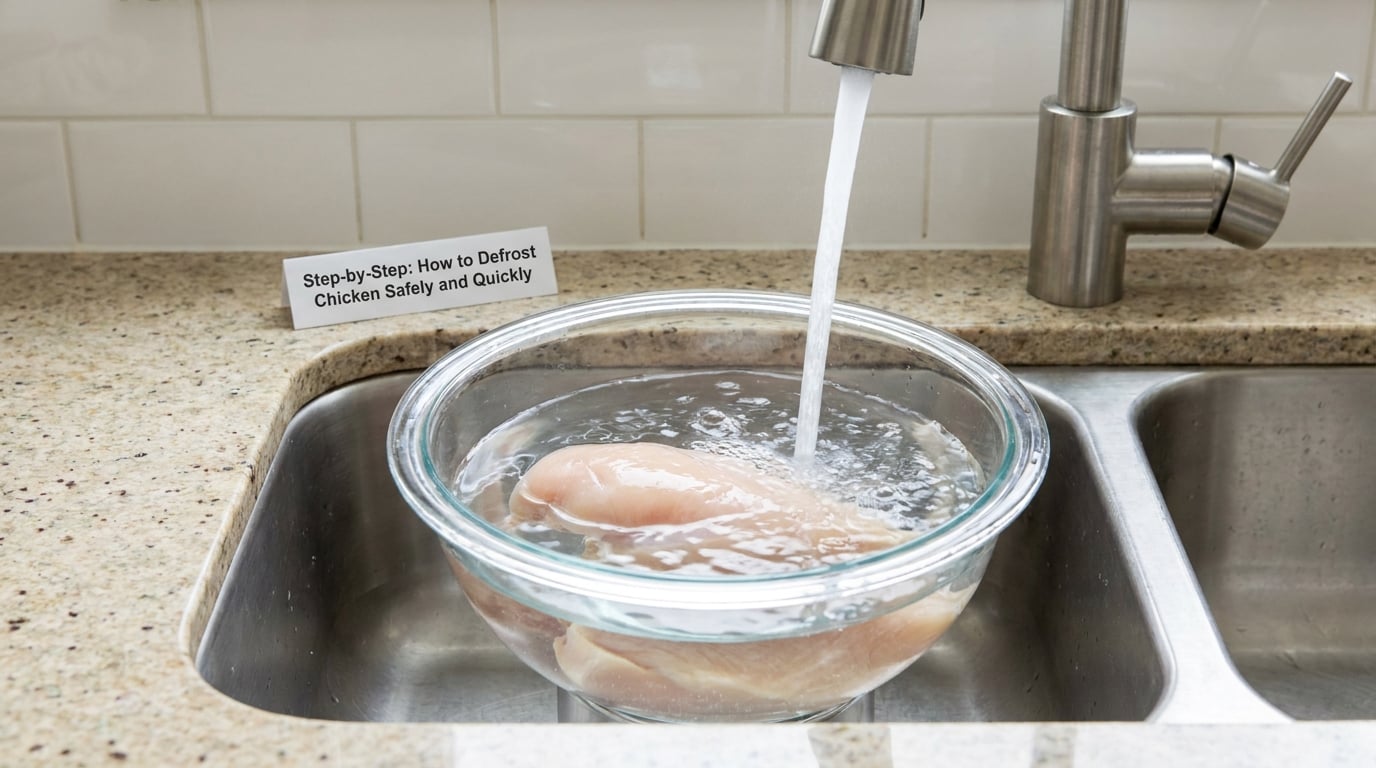
Submerge the sealed chicken in cold tap water in a bowl or the sink. It has to be completely covered. Change the water every 30 minutes so the bath stays cold, and never use warm or hot water, since the outside of the meat would enter the danger zone long before the center thawed.
Budget roughly 30 minutes per pound. A pound of boneless breasts takes about 30 minutes, a pound of thighs 30 to 45, and a whole chicken closer to 1 to 1.5 hours per pound.
Running water beats a still bath. A thin stream over the sealed bag carries away the warmth that builds up on the surface, and many home cooks on cooking forums report a real time saving from that small change.
Cook the chicken immediately after it thaws. Cold-water and microwave methods both end at the same place: the meat is in the temperature range where you cook it right now or refrigerate it right now.
Microwave Method: Fastest for Small Portions
Put the chicken on a microwave-safe plate. Set the microwave to defrost, or 30% power if your microwave has no defrost setting.
Thaw in short bursts. A pound of boneless breast takes roughly 4 to 6 minutes at 30% power. Check and turn or rotate the chicken every 2 minutes, separating pieces that are stuck together, since edges thaw long before the center.
Stop the microwave while the chicken still has small ice crystals or feels slightly firm. It will finish thawing on the counter in the few minutes it takes you to grab a pan, and going further leaves you with a rubbery, partly cooked texture.
This method suits a single breast, a few small pieces, or a chopped portion destined for a stir-fry. It is a poor choice for a whole chicken or a large bone-in piece, since the edges will dry out or cook before the middle softens.
Cook immediately, straight from the microwave into the pan or oven.
Cooking From Frozen: When It Is Appropriate
Yes, you can cook chicken from frozen. It is slower to cook and works best on thin, even portions such as fillets, strips, and flattened cutlets rather than a thick breast or a whole bird.
Set the oven to 375°F, put the frozen pieces in a single layer on a rimmed sheet pan, and give them about 50% longer cooking time than a thawed piece would need. For a pan-seared breast frozen solid, home cooks report 45 minutes in a 375°F oven producing solid results.
Check the thickest part with an instant-read thermometer. You need 165°F at the center, and the thermometer is the only reliable check, since a frozen breast can look done on the outside and still be raw in the middle.
Stir-fries, soups, and curries are the friendliest case, since small pieces thaw during the cooking process. Avoid searing frozen meat, since the cold surface prevents browning and the piece can stick to the pan.
How to Tell When Chicken Is Fully Thawed
Three cues tell you it is done. First, the meat is pliable: press a finger into the thickest part and the indentation springs back slowly, not instantly and not rock hard. Second, no ice crystals remain, and the piece bends without snapping.
Third, a marinade or sauce coats it evenly and you can slice into it. Color is not a useful test. Raw and thawed chicken can both look pink or pale, and refreezing leaves the meat slightly duller than it started.
If you have a thermometer, use it on the final cook, not the thaw. A chicken at 34°F is still safely cold and still frozen in the middle, so temperature alone will not tell you the thaw is complete.
One more check people miss: thaw state varies across the piece. The tail end of a breast can be soft while the thick end is still frozen, so check the widest section.
Thawing times by cut, at a glance
| Cut | Refrigerator | Cold water | Microwave at 30% |
|---|---|---|---|
| Boneless skinless breast | 12 to 24 hours | about 30 minutes per pound | 4 to 6 minutes per pound |
| Boneless thighs | 24 to 36 hours | 30 to 45 minutes per pound | 6 to 8 minutes per pound |
| Wings | 12 to 24 hours | 30 minutes per pound | 5 to 7 minutes per pound |
| Whole chicken, 4 to 5 pounds | 24 to 48 hours | 1 to 1.5 hours per pound | not recommended |
| Bone-in breasts | 24 to 36 hours | 45 minutes per pound | not recommended |
Two hours is enough for a pound of boneless breast in cold water, and not much else. If the piece is a whole chicken or bone-in, budget for the longer end of the range.
Common Mistakes
Thawing on the counter. The outer layer of the meat warms into the 40°F to 140°F danger zone while the center is still frozen solid, which is exactly the condition bacteria like. Fix: use the fridge, cold water, or microwave.
Using warm or hot water. It looks like a shortcut and it thaws the outside of the chicken while the middle stays frozen. Fix: cold water only, changed every 30 minutes.
Thawing in an open container. Juices run across the counter and into your sink. Fix: keep the chicken sealed, and on a tray in the fridge.
Running the microwave without checking. A single 10-minute burst turns the edges rubbery while the center stays frozen. Fix: 2-minute bursts, rotate each time, stop while there is still ice.
Refreezing chicken that has sat in the danger zone. Once the meat thaws, put it back in the fridge and cook it within 1 to 2 days, or freeze it immediately. If it has sat above 40°F for more than 2 hours, throw it out.
Cooking chicken that still contains ice. Ice dilutes the pan, slows the cooking, and uneven thawing leads to dry edges and a raw center. Fix: give it a few more minutes in cold water.
A couple of habits that make the rest easier: pat the chicken dry before seasoning so it sears instead of steams, and let it rest a few minutes after cooking so the juices redistribute.
Meal preppers who buy in bulk can batch-thaw a week of portions in one cold-water session, as long as each piece is sealed separately and the whole bath is changed on schedule. The reverse trick also works: marinating frozen chicken is fine for curries and stews, where the sauce and slow cooking thaw the meat as it cooks.
Frequently Asked Questions
Can I cook chicken if it’s still slightly frozen?
Yes, in most cases. Thin fillets, strips and flattened cutlets cook fine straight from frozen at 375°F, and give them about 50% longer than a thawed piece would need. A thick breast or whole chicken is harder, because the outside cooks before the center thaws. Check the thickest part with an instant-read thermometer and keep cooking until it reads 165°F, since appearance alone will not tell you.
Why can’t you defrost chicken at room temperature?
Because the outside of the meat enters the 40°F to 140°F danger zone long before the frozen center thaws. Salmonella and Campylobacter multiply quickly in that range while the middle of the chicken is still cold and icy, so the meat feels safe to the touch while bacteria are already growing on its surface. The USDA names the refrigerator, cold water and microwave as the only safe methods.
How long does it take to defrost chicken in cold water?
About 30 minutes per pound under cold running water, with the water changed every 30 minutes. A pound of boneless breasts takes roughly 30 minutes, thighs 30 to 45 minutes, and a whole chicken closer to 1 to 1.5 hours per pound. The chicken must stay sealed in a leak-proof bag and fully submerged, and it goes straight to the pan afterward, since it has been in the temperature range where bacteria grow.
Is 2 hours enough to defrost chicken?
Two hours is plenty for a pound or two of boneless chicken breast in cold water, and marginal for anything larger. Bone-in breasts need closer to 45 minutes per pound, thighs 30 to 45 minutes per pound, and a whole chicken of 4 to 5 pounds takes 1 to 1.5 hours per pound. In the refrigerator, two hours only works for a small portion, and most cuts need overnight.
Can you refreeze chicken after defrosting it?
It depends on how it was thawed. Chicken thawed in the refrigerator can be refrozen without any loss of quality, though a long thaw may have drawn some moisture out of it. Chicken thawed in cold water or the microwave should be cooked right away, and if you never cooked it, refreeze it immediately while it is still cold. If it sat above 40°F for more than 2 hours, discard it rather than refreezing it.
Conclusion
Start with the refrigerator for any meal you can plan a day ahead, since it is the only method that keeps the chicken below 40°F and gives you room to work. Forgot to take it out? Cold water at about 30 minutes per pound, changed every 30 minutes, then straight into the pan.
Reach for the microwave only for a single small portion, turn it every 2 minutes, and cook it immediately. And however the chicken got thawed, finish at 165°F in the thickest part before it goes on a plate.