
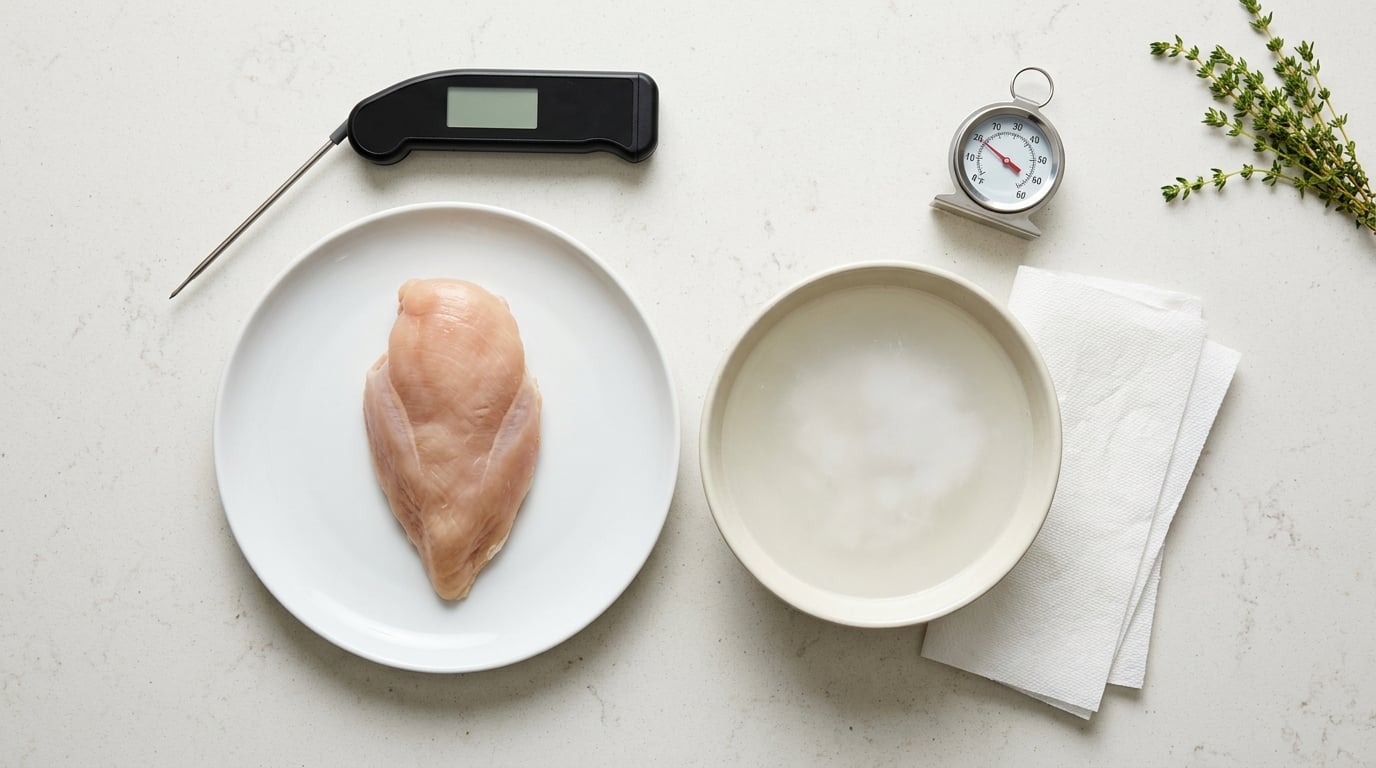
If you want to know how to tell if chicken has gone bad, run four checks in order: smell it, touch it, look at the color, and count the days it has been in the fridge. Spoiled chicken gives off a sour, sulfuric, or ammonia-like odor, feels slimy or tacky instead of firm and cold, and can turn dull gray, green, or yellow. That takes about two minutes and needs nothing more than a spoon and your nose.
The catch is that those checks catch spoilage, not every pathogen. Salmonella and Campylobacter can sit on chicken that still looks and smells fine, which is why a food thermometer reading 165°F (74°C) in the thickest part is the only real confirmation that the cooking time was enough.
This guide is general food-safety information, not medical advice. If you are pregnant, immunocompromised, caring for an older adult, or simply not confident, throw the chicken out and ask a doctor or your local health department.
Last reviewed: October 2026. Storage times follow USDA Food Safety and Inspection Service guidance; symptom timing follows CDC and FDA.
What You Need
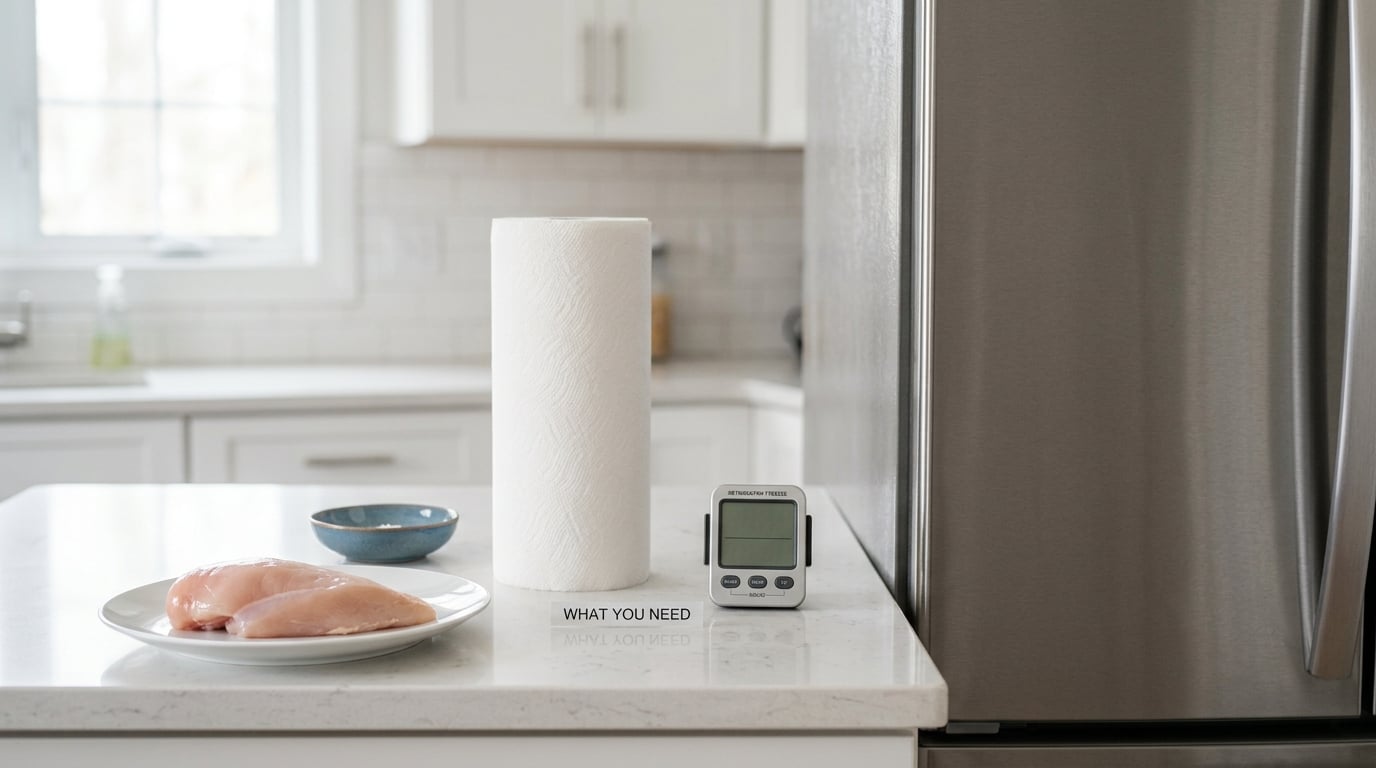
You do not need a lab. You need a place to work and something to throw the answer away into.
- A shallow bowl or plate so any liquid from the meat is visible instead of soaking into a cutting board.
- A separate cutting board, ideally one you only use for raw poultry, plus a knife you do not mind sanitizing after.
- Paper towels for the pat-dry test.
- Disposable gloves or clean hands washed with hot soapy water before and after.
- An instant-read thermometer for the cooked-chicken check.
- A refrigerator thermometer, which is honestly the most useful item on this list. A fridge running at 45°F turns a two-day window into a one-day one.
- A discard bag to carry the chicken straight out, so you never sniff it twice.
Wash your hands with hot soapy water, dry them, and clear a stretch of counter. Keep raw chicken away from ready-to-eat food the whole time you are inspecting it, because the juices you are looking at are exactly what you do not want on a salad.
Step-by-Step: How to Tell if Chicken Has Gone Bad
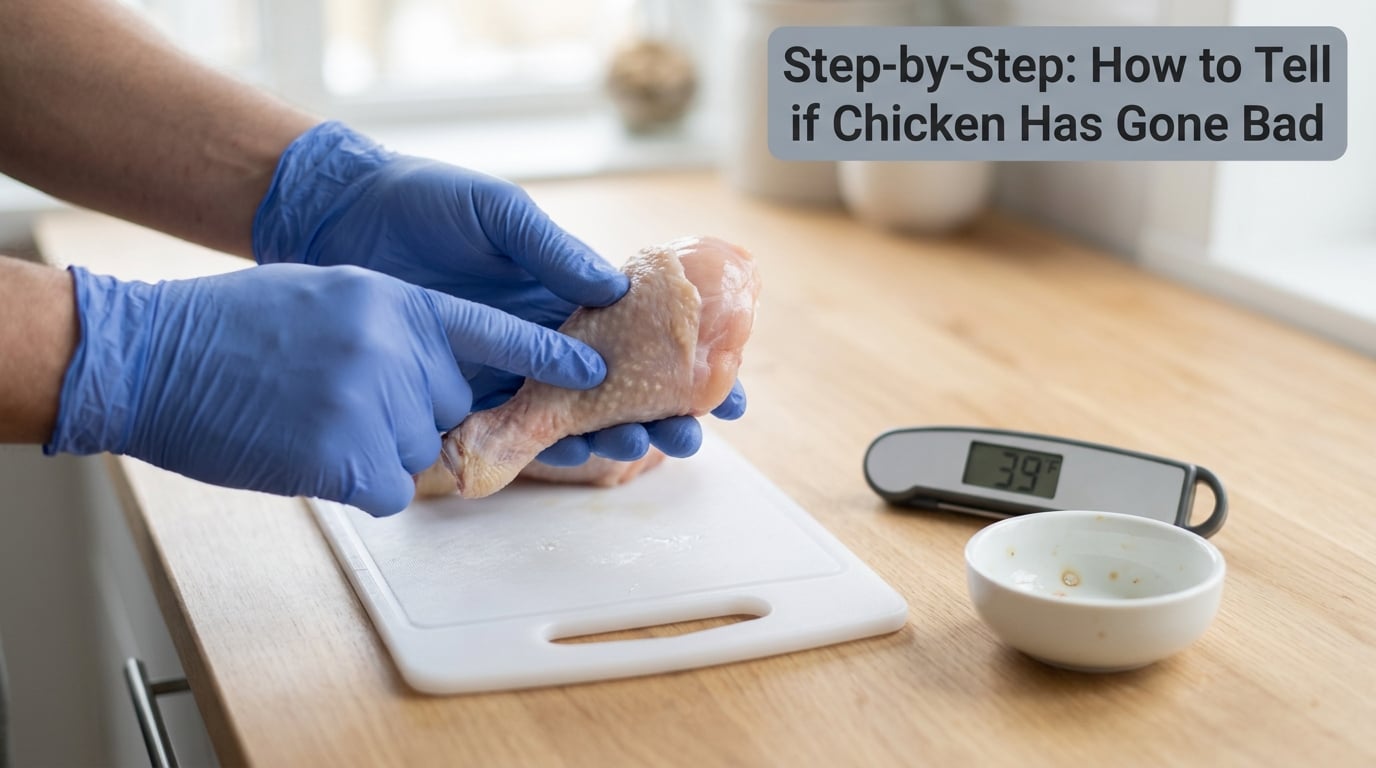
Here are the nine signs of bad chicken, in the order worth checking them.
- Sour, sulfuric, or ammonia-like smell. Fresh raw chicken has almost no odor. Anything pungent enough to notice from a few inches away is a reason to stop.
- Slimy, sticky, or tacky surface. Chicken that feels slippery or soapy instead of firm and slightly chilled has a bacterial film on it.
- Dull gray, greenish, or yellow patches. Fresh chicken is pale pink or peachy. Gray-green patches, especially along the edges, signal spoilage.
- Pooled liquid in the tray or bowl that looks thick, cloudy, or slimy rather than clear and thin.
- Damaged packaging: leaking, torn, swollen, or bulging sealed packs, or a use-by date already past.
- Mold on the surface, in the packaging liquid, or on cooked chicken.
- Time over the window: more than 1 to 2 days for raw chicken, more than 3 to 4 days for cooked chicken, at 40°F or below.
- Texture that has gone spongy or mushy on cooked chicken, especially with a dull gray cast instead of a white or clear interior.
- A sulfurous or eggy burst of odor when you open a vacuum-sealed pack. This one is a false alarm more often than not, and Step 2 explains when it is.
Step 1: Check the Package, Date, and Storage History
Start before you touch the food. Look at the tray, the bag, or the container. Liquid that has leaked out, a seal that has separated, or a vacuum pack that is puffed up like a balloon are all automatic discards, whatever the date says.
Then check where the chicken has actually been. Raw chicken kept on the fridge door, under a leaking container, or on a crowded top shelf is not what the label assumed. If you bought it on a Friday and it is Tuesday, that is already outside the USDA window for raw poultry.
| Chicken form | Refrigerator at 40°F or below | Freezer at 0°F |
|---|---|---|
| Raw chicken pieces (breasts, thighs, drumsticks, wings) | 1 to 2 days | 9 to 12 months |
| Raw whole chicken | 1 to 2 days | 9 to 12 months |
| Raw ground chicken | 1 to 2 days, same-day use is safest | 3 to 4 months |
| Cooked chicken and chicken leftovers | 3 to 4 days | 2 to 4 months |
| Rotisserie or deli-style cooked chicken | 3 to 5 days | Not recommended |
On date labels: a pack date is when the plant packed it, a use-by date is the manufacturer’s quality estimate, and a sell-by date is about turnover for the store. For chicken, treat the use-by date as the real deadline, and treat the sensory checks as the final word in both directions. Chicken that smells, feels, or looks spoiled is bad before the date, and chicken that passes every check on day one does not become bad because the printed date technically passed.
Step 2: Examine the Smell Before Cutting
Do not rinse raw chicken, and do not cut into it yet. Open the package, set the meat on its plate, and wait about 15 minutes so any concentrated odor dissipates and you are not fooled by trapped packaging air. Then smell it.
Fresh raw chicken is nearly odorless. You might notice a very faint neutral or meaty scent, and that is normal. Conventional and cheaper chicken sometimes carries a slightly stronger smell than free-range or organic, which is a baseline difference rather than spoilage, so learn what your usual pack smells like.
Signs that chicken is off include a sour or pungent odor, a sharp ammonia note like a cleaning product, a rotten-egg or sulfur smell, or any odor that makes you pull your head back. Home cooks on cooking forums are near-unanimous that there is rarely real ambiguity at the extreme end: bad chicken announces itself, and the people who keep tasting it to be sure are the ones who end up sick.
One important false alarm. Vacuum-sealed and modified-atmosphere packs sometimes release a brief sulfurous or eggy puff when opened. That is a packaging reaction, not spoilage. Judge the meat after the odor clears, using the next two steps.
Step 3: Look for Changes in Color and Texture
Color alone cannot prove safety, which is why experienced cooks never rely on it. Raw chicken breast is pale pink, thighs and drumsticks are slightly deeper, and both go paler and more opaque as they cook. Some chicken is naturally grayish before it ever hits heat, and darkening on the edges is sometimes just myoglobin reacting with air.
What concerns me is a dull gray-brown surface across the whole cut, greenish or iridescent patches, yellow staining around the edges, or a cooked piece that has gone gray and translucent instead of opaque white. Those changes come with bacterial growth rather than a free-range chicken’s darker meat.
For texture, press the meat with a fingertip. Fresh raw chicken is firm, cold, and springs back. Spoiled chicken feels slick, soapy, or tacky, and a thin film can sometimes be lifted off the surface with a paper towel. Poultry also develops an off odor that clings to your fingers after you touch it, and that sticky residue that rinses off a fresh piece but not a spoiled one is a clue worth trusting.
| Sense | Fresh chicken | Spoiled chicken | Action |
|---|---|---|---|
| Smell | Nearly odorless or faintly meaty | Sour, sulfuric, ammonia-like, rotten egg | Discard, do not taste |
| Touch | Firm, cold, springs back | Slimy, sticky, tacky, soapy film | Discard |
| Color | Pale pink, peach, opaque white when cooked | Dull gray, greenish tint, yellow patches | Discard, especially with slime or smell |
| Date and time | Within 1 to 2 days raw, 3 to 4 days cooked | Past the window, or unknown history | Discard if any doubt |
| Frozen state | Firm, no ice crystals, no freezer burn | Frozen solid with heavy ice, refrozen clumps | Check after thawing in the fridge |
Freezer burn is a separate thing and it is not spoilage. It shows up as grayish-white dry patches, leathery edges, and ice crystals, caused by air reaching the surface in the freezer. Freezer-burned chicken is safe. Chicken that looks dull after freezing is not automatically bad, which is why the smell and texture checks carry more weight than the color.
Step 4: How to Tell if Cooked Chicken and Leftovers Have Gone Bad
Cooked chicken spoils on its own schedule. Two hours is the window for getting it into the fridge, and one hour if the room is above 90°F. Once refrigerated, cooked chicken and leftovers get 3 to 4 days, and rotisserie or deli-style chicken gets 3 to 5 days.
Raw poultry and cooked poultry are different animals. Raw chicken goes off with smell, slime, and color. Cooked chicken often gives a milder warning, which is a problem because there is less of it. Watch for a faint sour or musty note in the reheating steam, a surface that looks dull and gray instead of white, a skin or outer layer that has gone slimy, and a texture that has turned rubbery or stringy.
Two habits make leftovers riskier than they need to be. Leaving them in shallow containers stacked in a pile means the middle never cools fast enough. And reheating the same container for leftovers, then putting the rest back in it, walks contamination from the plate to the fridge and back out again. Separate containers each time.
If a package looks like a question mark, if the history is fuzzy after a power outage, or if the meat came from an unlabeled container, discard it. You are not trying to prove the chicken is safe. You are trying to avoid the one case where being wrong costs you a trip to urgent care.
Step 5: Use Temperature and Cooking Guidance
This is the part that catches what your nose cannot. Appearance, smell, and touch are excellent at detecting spoilage and completely blind to pathogens. Salmonella, Campylobacter, and Clostridium perfringens can be present on chicken that passed every check, because those organisms do not have to spoil the food to make you ill.
Cook poultry to an internal temperature of 165°F (74°C), measured with an instant-read thermometer in the thickest part, not touching bone. For a whole bird, check the innermost part of the thigh and the thickest part of the breast. For ground chicken, 165°F still applies. Take it off the heat at 165°F or the temperature the USDA recommends, and remember that carryover cooking adds a few degrees on rest.
The critical point: cooking kills most live bacteria but it does not neutralize heat-stable toxins. Some of the compounds produced when bacteria spoil food survive a skillet at high heat, which is why a piece of chicken that already smells bad is not rescued by cooking it harder. The FDA and CDC both treat time and temperature as the primary controls, with spoilage signs as a trigger to discard, not as a green light to keep cooking.
Prevent cross-contamination while you do this. Raw poultry juices carry bacteria, so keep the breast, thighs, or ground meat on its own board, away from produce and cooked food, and wash hands, utensils, and surfaces with hot soapy water afterward. For storage, put raw chicken on the bottom shelf in a sealed container so nothing can drip onto what you plan to eat raw.
Common Mistakes
Most bad chicken decisions come down to a handful of habits that feel reasonable and are not.
- Judging by color alone. Color is the weakest of the four checks. Cook chicken on its own smell, texture, and date, not because a piece of meat looks a particular shade.
- Tasting to check. There is no safe way to sample questionable chicken. A small taste is still a dose of whatever grew on it, and heat-stable toxins are not the flavor of the food.
- Overriding a bad smell. If the odor makes you flinch, it is finished. People on cooking forums say the same thing in different words: if it smells bad, throw it out.
- Rinsing raw chicken. Washing splashes raw juices across your sink, counters, and other food. Cooking kills the bacteria, so the rinse buys contamination and cleanliness theater.
- Stretching the storage window. Five days in the fridge for raw chicken is well past the USDA guidance, and the same goes for cooked chicken after four. If the date is a guess, treat it as a discard.
- Assuming cooking fixes it. Heat kills live bacteria, but not every toxin they already left behind. Chicken that is slimy or sour before cooking does not become safe by being cooked.
If you have a reduced sense of smell, whether from a recent cold, allergies, COVID, smoking, or simply age, do not treat your nose as a working tool. Run the other three checks: look for slime, gray-green or yellow color, and pooled liquid, and count the days in the fridge. If any two of those are borderline, the answer is throw it out. The same fallback applies after a power outage: if you cannot confirm the fridge held 40°F or below the whole time, perishable food in it goes into the bin.
And if you already ate questionable chicken, do the sensible thing instead of the anxious thing. Symptoms from Salmonella usually show up 6 to 72 hours after eating, and Clostridium perfringens tends to cause cramps and diarrhea 8 to 16 hours later. Call a doctor right away for bloody stools, a high fever, persistent vomiting, signs of dehydration, severe muscle aches, or any of this during pregnancy or while immunocompromised, and seek urgent care for those symptoms rather than waiting them out at home.
Frequently Asked Questions
How can you tell if raw chicken is bad?
Run four checks in order: smell it for a sour, sulfuric, or ammonia-like odor, press it for a slimy or tacky surface, look for dull gray, green, or yellow color, and count the days in the fridge. More than 1 to 2 days at 40F or below is past the USDA window. Any one of these signs means discard, and never taste to confirm.
Is chicken bad if it smells a little unusual?
Fresh raw chicken is nearly odorless, so any smell you actively notice is a warning. A brief sulfurous or eggy puff when you open a vacuum-sealed pack is a packaging reaction, not spoilage: wait 15 minutes and re-check. A sour, pungent, or ammonia note that persists is spoilage, and cooking will not make it safe.
Does pink chicken mean it is spoiled?
No. Raw chicken breast is naturally pale pink and thighs are a little deeper, and darkening on the surface is often just myoglobin reacting with air. Color alone cannot prove safety either way. Pink chicken is fine if it passes the smell and texture checks and you cook it to 165F (74C) internally.
How long can chicken stay in the refrigerator?
At 40F or below, the USDA allows 1 to 2 days for raw chicken pieces, whole birds, and ground chicken, and 3 to 4 days for cooked chicken and leftovers. Rotisserie and deli-style cooked chicken keep 3 to 5 days. Five days for raw chicken is past the window, and if the fridge was warmer than 40F, shorten these times.
Can you safely reheat chicken that has been out of the fridge for hours?
No. Cooked chicken left out longer than 2 hours, or 1 hour in temperatures above 90F, sits in the food danger zone where bacteria multiply fast. Reheating kills many live bacteria but does not neutralize the heat-stable toxins spoilage bacteria leave behind, so reheat nothing that sat out that long. Discard it instead.
Does cooking kill all bacteria in spoiled chicken?
It kills most live bacteria, but not every compound they produced while the food sat out. Heat-stable toxins survive high cooking temperatures, which is why a slimy, sour piece of chicken stays unsafe even when well done. That is also why the safe path is to discard chicken that fails the sensory checks, not to cook it harder and hope.
Conclusion
The first action is simple: do not taste it. Open the package, wait a beat, then check smell, texture, color, and the calendar in that order. If anything reads wrong on any of the four, put it in the bag and take it out, because when in doubt, throw it out.
And when the chicken passes every check, still finish with the thermometer. A verified 165°F (74°C) in the thickest part is the only thing that confirms time and temperature worked, and it takes eight seconds to check. Start there the next time a package of chicken has been sitting in the back of the fridge for a while and you are not sure.