
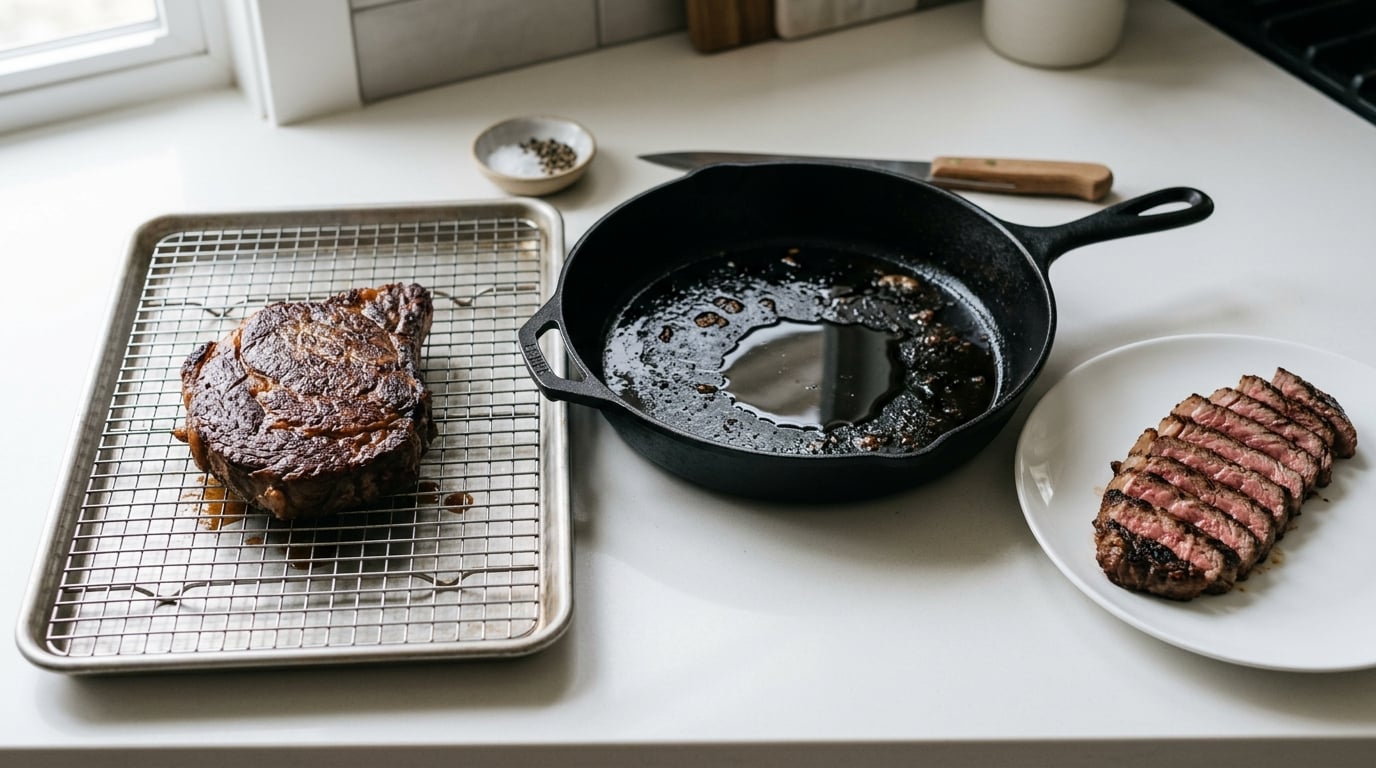
The best way to reheat steak without overcooking it is to warm it slowly in a 250°F oven on a wire rack until the center reaches about 110°F, then give it a 60 to 90 second sear per side in a hot cast-iron skillet. The oven does the gentle work, the sear brings back the crust, and a thermometer tells you when to stop.
That stop signal is the whole game. Most people ruin reheated steak by cooking on instinct, waiting for the middle to “look done,” and by the time it looks done it has been sitting at medium-well for several minutes. Carryover heat finishes the job while the steak rests, so you pull it early on purpose.
Worth knowing why this happens. Steak that has already cooked once has muscle fibers that have contracted and collagen that has tightened. Heat them a second time and they contract again, squeezing out the water that made them tender. A slow warm-up plus a short blast of heat does far less damage than one blast alone, which is exactly the trade-off people argue about on r/steak and r/Cooking. The low-oven-then-sear camp is right for most home cooks; sous vide regulars get a gentler result but spend the whole prep and cleanup on it.
Before you start, two questions decide everything: is the steak whole or already sliced, and how was it originally cooked? A whole ribeye warmed in the oven needs completely different handling from strips for fajitas, and a steak that started medium-rare needs a much earlier pull than one that started medium-well.
What You Need
None of this is specialist equipment, and most of it is optional in a pinch. But each item removes one of the ways steak usually goes wrong.
- The steak. Take it out of the fridge 15 to 20 minutes before you start. A piece at fridge temperature needs far longer in the oven than one that has come halfway to room temperature, and that extra time is where the drying happens.
- A wire rack and a rimmed baking sheet. The rack holds the meat above the pan so hot air circulates underneath. The sheet catches the drippings and, more importantly, keeps the bottom from sitting in its own liquid and steaming.
- An instant-read thermometer. This is the single most important tool on the list. Time is a rough guide; a temperature reading is the real stop signal.
- A cast-iron skillet or heavy stainless pan. Something that holds heat well and can survive a hard sear without warping.
- A small amount of neutral oil. Enough to keep the surface from gluing and to let the crust actually crisp. Olive oil works too, it just has a lower smoke point.
- Aluminum foil. For tenting thin cuts so they do not over-blast before the center is warm.
- A little beef broth or pan juices. Optional, but a tablespoon added to the skillet after searing makes a fast sauce and puts moisture back.
Step-by-Step: How to Reheat Steak Without Overcooking It
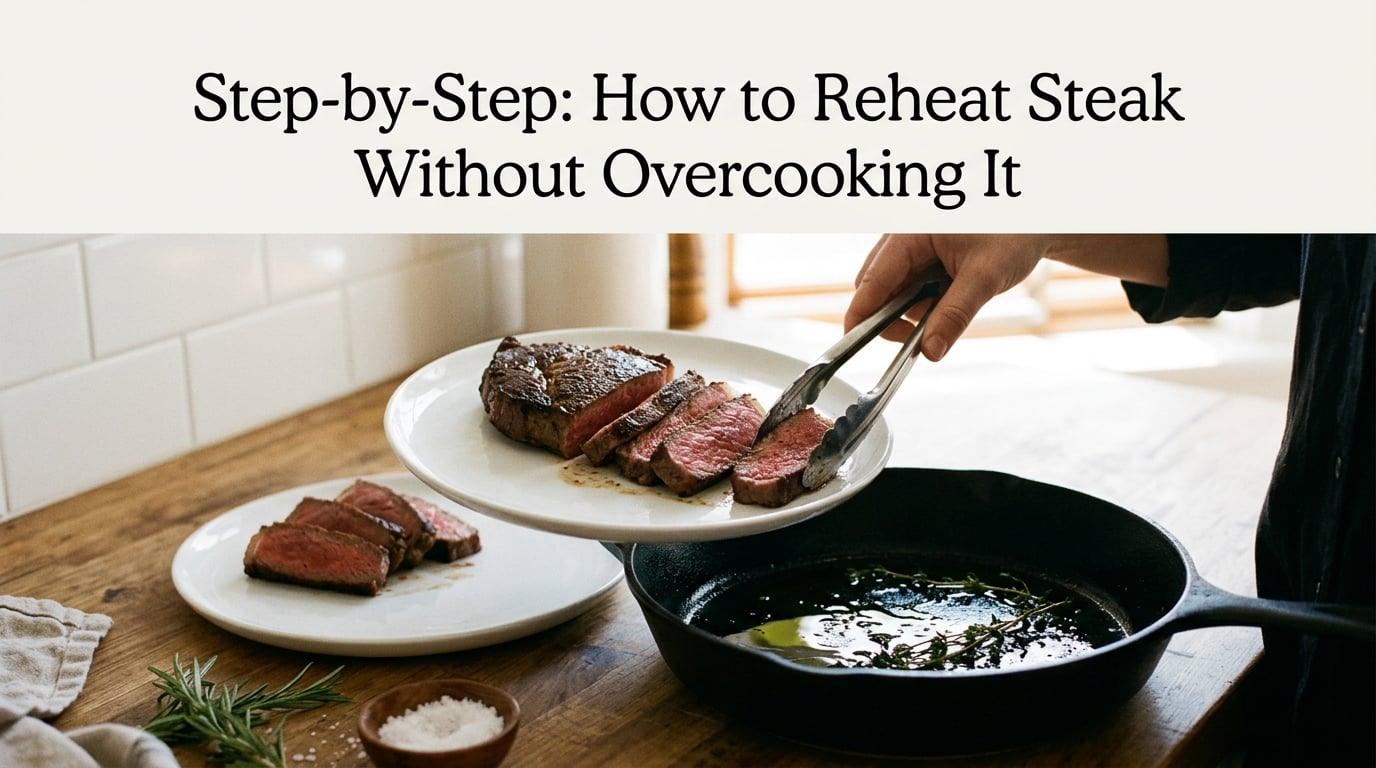
Most of the work is done before the heat goes on. Here is the order I use, and it works the same for a whole steak or for slices.
- Bring the steak toward room temperature. Set it on a plate 15 to 20 minutes ahead. Skipping this is the most common reason a reheat runs long and dries out.
- Pat the surface dry. Moisture on the outside is what stops a sear from browning. Blot it with a paper towel before it ever meets heat.
- Choose the method. Whole thick cut: oven, then sear. Sliced or fajita strips: skillet or air fryer. No oven at all: skillet, and skip straight to the sear step.
- Warm it gently. Heat the oven to 250°F, set the steak on the rack, and give it about 15 minutes for every 3/4 inch of thickness.
- Check early and check often. Probe the thickest part with the thermometer at the halfway point rather than waiting for the timer. You want roughly 110°F in the center, then out of the oven.
- Sear to finish. Get a cast-iron skillet properly hot, add a thin film of oil, and give the steak 60 to 90 seconds per side. This is for crust, not for cooking.
- Rest before slicing. Five minutes on the board. The juice that runs out during that sear redistributes back into the meat, which is the step almost everybody skips.
Skillet Method for a Quick Reheat
The skillet is the fastest route and the best one for thin steaks, flank, or anything already cut into slices. It is also the easiest to overcook, so the thermometer earns its keep here.
- Heat a cast-iron skillet over medium heat, add a small amount of oil, and let it shimmer before the steak goes in.
- Lay the steak down and leave it alone for 2 to 3 minutes on the first side for a thick piece, or 60 to 90 seconds for slices. Resist the urge to move it.
- Turn once, cook the second side the same way, and check the temperature before you add any more time.
- Deglaze the pan with a splash of beef broth, scrape up the browned bits, and spoon that back over the steak.
The cue to watch is the juice. When it runs clear and beads on the surface rather than streaming red, you are close. A steak that has already been cooked needs far less time here than you would give a raw one, which trips up anyone used to searing fresh cuts.
Oven Method for Even, Gentle Heating
The oven is the best method for a whole, thick steak, and it is the one I would pick when the piece is an expensive cut worth saving. Low, even heat warms the center before the outside has a chance to dry out or burn.
- Heat the oven to 250°F. Anywhere from 200 to 250°F works; lower is gentler and a little slower.
- Set a wire rack on a rimmed baking sheet and place the steak on it.
- Plan for roughly 15 minutes per 3/4 inch of thickness. A 1.5 inch steak takes about 30 minutes; a thinner sirloin is closer to 10.
- Probe the center at the halfway mark. Pull at about 110°F, or somewhere around 115°F if the original cook was medium or further along.
- Rest 5 to 10 minutes, then finish with a quick skillet sear if you want the crust back.
For thin cuts and fajita strips, the oven works too but at a shorter setting, around 200°F, so the edges do not turn leathery before the middle warms. Tent loosely with foil and check at 6 to 8 minutes. Anyone who has wrapped steak tightly in foil and left it for half an hour knows the dry result this replaces.
Microwave Method with a Final Sear
The microwave is the fastest option and the worst on its own. Run it at full power and the outside turns rubbery while the center stays cold, which is the most common complaint on r/cookingforbeginners. Use it only as a warming step, never as the finish.
- Set the microwave to 50 percent power.
- Cover the steak with a damp paper towel and put it on a microwave-safe plate.
- Run 30 second bursts, turning the steak between each one. Thick pieces need three or four bursts; slices usually need one.
- Let it stand for a minute so the heat spreads through.
- Finish in a hot skillet with a little oil, 30 to 45 seconds per side, to give it back some browning.
The damp towel is doing real work here. It traps steam that keeps the surface from tightening, the same way a splash of water rescues dry rice.
How to Tell When the Steak Is Hot Enough
Stop by temperature, and check in more than one spot. A leftover portion is often uneven, a corner of ribeye next to a thin slice, and those two areas heat at very different rates. Probe the thickest part, then the thin end, and believe the cooler reading.
As a quality target, aim to stop warming at about 110 to 115°F in the center. Residual heat carries the steak to roughly 135 to 140°F by the time it reaches the table, which is medium and still moist. Pull it earlier if the original cook was rare, later if it was already medium-well.
For safety, treat 110°F as a quality decision rather than a safe one. The USDA recommends reheating cooked leftovers, including beef, to 165°F, and 145°F with a rest for whole cuts of beef. Those are the numbers to follow if anyone in the house is pregnant, elderly, immunocompromised, or simply cautious. Reheat leftovers once only, and get refrigerated steak back into the fridge or the oven within two hours.
How to Reheat Steak Without Overcooking It: Common Mistakes and Fixes
- Cranking the heat. A 400°F oven browns the outside while the middle stays cold. Fix: 200 to 250°F, and start checking early.
- Microwave on full power. Fix: 50 percent power, 30 second bursts, and always finish with a skillet sear.
- Going straight from the fridge into heat. The steak spends the whole time making up its own temperature difference. Fix: 15 to 20 minutes out first.
- Overcrowding the pan. Pieces touching each other steam instead of sear. Fix: one layer, or cook in batches. In an air fryer, the same rule applies, at 350 to 360°F for 3 to 5 minutes on sliced steak.
- Salting too early and too heavily. Salt draws moisture to the surface before there is any heat to seal it. Fix: season after the reheat, right before serving.
- Skipping the rest. Fix: five minutes on the board. The steak keeps cooking and the juices redistribute.
- Wrapping foil around the steak and leaving it. Foil is for a short tent, not a full wrap for the whole warm. Fix: loose tent, then uncover for the last few minutes.
If the steak is already past the point of no return and overcooked, stop trying to sear it back to life. Slice it thin against the grain, soak it briefly in warm beef broth, and use it as the start of a stir fry or a steak hash. Shredded over noodles with a hot pan sauce works well too. Those dishes forgive a dry piece in a way a plain plate never does.
Frequently Asked Questions
Can you reheat steak more than once?
No. Reheating cooked steak repeatedly dries it out badly and the texture never recovers. The USDA guidance is to reheat leftovers once only. If you have more steak than you can eat in one sitting, freeze the extra portions right after the first cook rather than warming them back to 165°F and storing them again.
What is the best way to reheat a medium-rare steak?
Warm it in a 250°F oven on a wire rack and pull it as soon as the center reads about 110°F. Residual heat takes it to medium during the rest, so you get a hot steak without cooking it far past where it started. Sear 60 to 90 seconds per side afterward for crust, then let it rest five minutes before slicing.
How long do you reheat leftover steak for?
About 15 minutes in a 250°F oven for every 3/4 inch of thickness, so roughly 25 to 30 minutes for a thick ribeye and under 10 minutes for a thin sirloin. Check with an instant-read thermometer at the halfway mark and pull around 110°F. Sliced steak for fajitas needs only 3 to 5 minutes in a skillet or air fryer.
Does reheating steak in the microwave dry it out?
Yes, if you use full power. High heat drives moisture out fast and leaves the outside rubbery while the center lags behind. Set it to 50 percent power, run 30 second bursts with a turn between each, cover with a damp paper towel, and finish in a hot skillet. The microwave warms; the pan gives you the crust.
Is it better to reheat steak in the oven or an air fryer?
The oven wins for whole steaks because low, even heat warms the center before the surface dries. An air fryer is faster and crisper for sliced steak, which cooks in 3 to 5 minutes at 350 to 360°F, but it burns edges fast if the basket is crowded. Use the oven for thick pieces and the air fryer for slices and fajita strips.
How do you fix an overcooked steak?
You cannot make dry steak juicy again, so change the format instead. Slice it thin, let it sit in warm beef broth for a few minutes, and serve it in a stir fry, a steak hash, or over noodles with a hot pan sauce. A thin cut in a saucy dish is far more forgiving than a thick one on a bare plate.
Conclusion
The first step is the one that decides the outcome: take the steak out of the fridge 15 to 20 minutes early and let the oven do the warming at 250°F rather than blasting it. Then trust the thermometer instead of the clock, pull it at about 110°F in the center, and let the rest and the sear finish the job.
If you try one thing from this, make it the oven plus skillet sear. It is the balance of moisture and crust that works across ribeye, sirloin and flank, and it is the same method line cooks reach for when an order of prime rib needs re-firing.
Update for 2026.